
Australian Luthiers
Australia has a thriving community of classical guitar makers and luthiers - highly skilled and respected in the international music community.
At GuitarsOnline we pride ourselves on supporting the growing Australian classical guitar making industry, with guitars from Australian luthiers currently in stock that include:
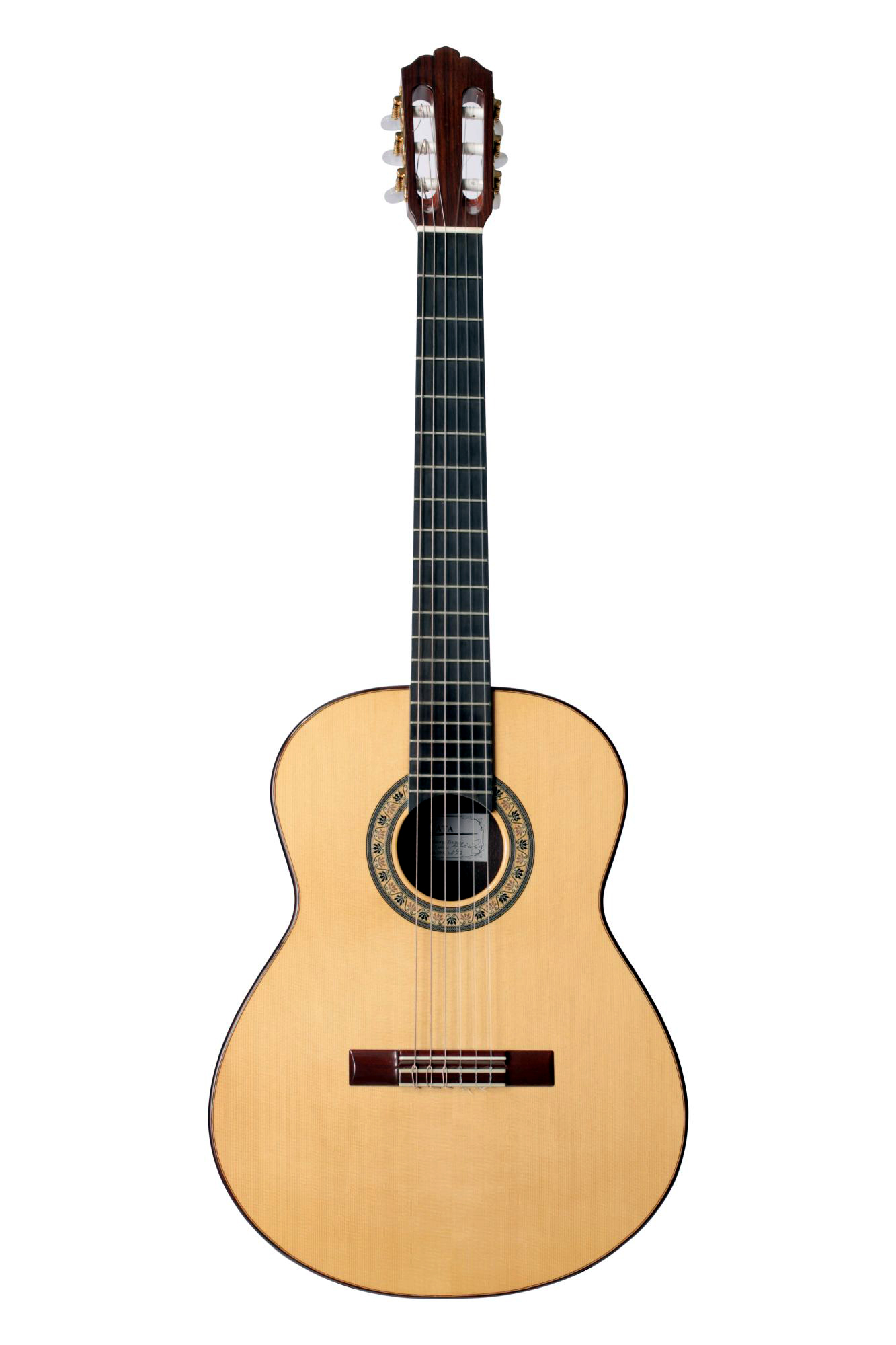
George Ziata is a South Australian guitar maker, building guitars since 1991, specialising in lattice braced classical guitars.
The Ziata Guitars workshop is dedicated to building classical guitars and is equipped with state of the art equipment. Only the finest quality timbers are used and by utilising the most technologically advanced methods and materials all guitars posses the very best quality sound and workmanship.
Soundboard Construction:
Lattice-braced carbon fibre reinforced soundboard design, made by combining traditional designs with the modern lattice design giving the guitars their special character. The advantage of a lattice design is its lighter weight, superior strength and the shape of the lattice stimulates the soundboard more than a traditional fan-braced guitar. The soundboard is domed which creates strength and a finer quality sound.
12th fret position:
The 12th fret is slightly further away from the body than other classical guitars. The body and neck meet at the 14th fret, this is commonly found on acoustic steel-string guitars. Ziata found this feature to be more useful when playing in the higher positions on the fretboard. In moving the 12th fret Ziata was able to fit in a 20th fret without obstructing the sound hole and interfering with the projection of sound.
Guitar Neck:
The neck is made from Honduras Mahogany and reinforced with a carbon fibre rod. The method I use for gluing the carbon fibre infuses the fibre to the timber.
Lacquer finish:
A two part lacquer provides the guitar with very good protection and is the best available modern blended Lacquer for finishing guitars. This lacquer provides a finish that looks deep and by applying a thinner coat it prevents muffling of the sound. After full curing of the finish the guitar is then buffed to a very high gloss.
Specifications:
Fretboard = Ebony
Bridge = African Paduak
Back & sides = Indian Rosewood
Neck = Honduras Mahogany
Headstock veneer = Indian Rosewood
Binding = Indian Rosewood / rock maple 1.2mm wide decorative strip
Sound board = Engelmann Spruce
Inside strutting = Carbon fibre / Balsa wood Lattice Braced
Tuning machines = Gotoh premium range tuners
Frets = 20, Scale length =650mm
Case = Deluxe ABS Road Case
This guitar was bought new in 2007 and has had only one owner. It was recently traded in for a more expensive instrument. Ziata's classical guitars currently sell for $7,800 new.
Dan Nistico’s comments when recording with it were “Very nice. You get a bonus 20th fret for that one piece that has it. Just playing different registers to give you an idea. Very nice, very responsive in all registers, very easy to play. Great sound for a lattice braced because the Spruce top gives it punch. Plays tears in heaven (Sato arrangement)”

Description: 1996 Jeff Kemp Concert Classical Guitar
=> please CLICK HERE to see this guitar in action:
Guitar Specs:
Greg Smallman style “Lattice” bracing Top: Cedar (very thin)
Back and Sides: Rosewood. Fingerboard: Ebony. Tuners: Sloane Ebony knobs.
Finish: Back & Sides only: Very thick Lacquer used on Yacht hulls.
Removable custom Arm rest added for comfort.
Guitar Case: Original Hiscox case included
Condition: Very good.
This guitar has only had two owners and was built for Raffaele Agostino a well know Sydney based performer, recording artist and Sydney conservatorium teacher who together with Janet Agostino founded the Sydney Guitar Quartet.
Raff used the 1996 Jeff Kemp in the recording of the Australian seminal work in 1998 he released a CD “Whispering from the cedar top” of solo guitar music of Australian composers Richard Charlton and Phillip Houghton.
He is currently the Artistic Director of the Classical Guitar Society, Sydney and Assistant Lecturer in Guitar at the Sydney Conservatorium.
This guitar was later acquired by one of Janet Agostino’s Students.
About This Guitar
Jeff Kemp began building guitars in 1982. His workshop is located at Rockvale, 35km from Armidale in the New England Area of NSW Australia.
The area is part of the Northern Tablelands with an elevation of 1000 metres and a dry climate ideal for guitar making.
His approach to building is to combine the finest elements of a traditionally built guitar with contemporary materials, building methods and design. The result is a powerful, well-balanced guitar with enhanced volume and projection.
These guitars have been described as “New Generation” instruments which are capable of projecting their rich sound in very large concert spaces.
Jeff has a book currently in print on the characteristics of wood available in the Australian market called appropriately enough “The Australian Timber Buyers Guide” Commissioned by – Skills Book Publishing. Sydney 1994 .
Current production is around ten guitars per year. “I was planning to record on guitar but due to the current global situation i decided to sell off some of my guitar collection.”
Precis
In his own words Jeff's approach to building is to combine the finest elements of a traditionally built guitar with a blend of traditional and contemporary materials, building methods and design. The result is a powerful, well-balanced guitar with enhanced volume and projection.
These guitars have been described as "New Generation" instruments which can project their rich sound in very large concert spaces.
They respond to the slightest of touches and are capable of being driven hard without being overpowered, resulting in an extremely wide dynamic range.
Most importantly, this style of building provides the musician with a vast palette of tonal variation to explore a complex array of sounds within the context of the purest and richest timbre.
More about the building of this guitar’s Construction:
The overall design idea is to build an instrument with heavy and extremely stiff back and sides, allowing greater freedom in soundboard construction.
Using this method, less energy is taken from the soundboard by thin sides and there is less interaction between the back and the top via the air volume. This means that the back is not trying to behave like a second soundboard.
The result of this is a more efficient soundboard capable of greater volume and dynamic range. This gives the guitarist a very usable palette of tonal possibilities which span the entire (extremely wide) dynamic range of the instrument.
The backs and sides are made of Brazilian Rosewood with the backs being arched in the same style as a cello back.
This is achieved by laminating Brazilian Rosewood with epoxy resin to a critical thickness allowing the desired stiffness with no internal bracing.
With the thickness involved in achieving the desired effect, it is almost impossible to construct using solid wood. The forces of expansion and contraction of solid wood construction at these thicknesses would eventually result in joint failure and severe cracking.
Jeff uses cedar for soundboards almost exclusively as he prefers the warmer, darker sounds inherent in cedar. He does make spruce guitars but continues to receive more orders for cedar than spruce.
All braces are Balsa/Carbon Fibre composite and bracing patterns are of non-traditional design.
Necks are made from Honduras Mahogany and incorporate an adjustable truss rod which adjusts in both directions to counteract both back and forward bow. This allows Jeff to build the correct curvature into the fingerboard when he is making the guitar, and to allow for neck adjustment if nechttps://www.news.uct.ac.za/article/-2012-08-06-unique-guitar-a-joy-to-makemusic-onessary. Temperature and humidity changes do affect the neck, so the truss rod is available to allow adjustment if needed.
Material selection is of an extremely high standard and only the best ‘Master’ grade woods are selected and utilised in the construction of Jeff’s instruments.
What do other Players say?
Unique guitar “a joy to make music on” 06 AUGUST 2012
https://www.news.uct.ac.za/article/-2012-08-06-unique-guitar-a-joy-to-makemusic-on
Strumming beauty: James Grace strokes the hand-made guitar he acquired recently from a renowned Australian luthier. Classical guitars are not only capable of producing breathtakingly beautiful sound; they are also instruments of exquisite elegance. All the more so when the instrument has been handcrafted by a master luthier who produces only four to six instruments per year.
This is the kind of masterpiece James Grace (head of classical guitar studies at UCT’s South African College of Music) acquired recently. His handmade six-string classical guitar was produced by Jeff Kemp in a remote town near Armidale, halfway between Sydney and Brisbane, Australia. Grace says Kemp played his CDs in the workshop while he was making the guitar so that “he (Kemp) could try and recreate the same type of sound I was used to”. Grace is no stranger to Kemp’s craftsmanship. He bought one of Kemp’s guitars in 1995, second-hand.
His latest acquisition cost upward of R100 000.
After he fetched the guitar from Australia, all he wanted to do was to start playing it. “It felt a bit unfamiliar, but after spending a few hours just exploring the different sounds I could get from the guitar, I started to get used to it, and it became a joy to make music on,” says Grace.
What does Guitarscope say?
Home Music community Performance hall Composing Violin workshop Guitar classroom Shopping guide gallery Asia | Europe | North America | South America | Australia | Africa Guitar Workshop > Australia > Kemp >Test Report
After a long period of testing and consultation, we finally released the The Jeff Kemp Guitar test report. This report synthesizes the impressions and evaluations of The Jeff Kemp Guitar from ourselves, the teachers and students of the Conservatory of Music, professional guitarists, senior guitar teachers and guitar friends. We believe that these evaluations are comprehensive, objective, and exciting.
We are here to talk to Mr. He Qing from Tianjin Conservatory of Music, Mr. Lai Kangkang and Mr. Guo Yucheng from Beijing Philharmonic Guitar Orchestra, Mr. Yang, Mr. Xu from Zhongqing Musical Instrument, Mr. Raimundo, Director of the Guitar China Club and his two friends, as well as other participants who participated in the test. My friend expressed my heartfelt thanks.
Guitar Scenery officially began to provide the ordering service of Jeff Kemp concert guitars in Asia. The Jeff Kemp Guitar’s 2003 international guitar sold for $6000-6500. The guitar scenery line and Master Jeff Kemp decided together to provide a substantial discount for his friends who buy the first The Jeff Kemp Guitar in China.
Jeff Kemp Concert Guitar test report
Compared with guitars made in factories and small workshops, concert guitars emphasize personality and art, which incorporates the unique personality and philosophy of the producer.
The Jeff Kemp Guitar is the first concert guitar launched by Guitar Scenery. From the shocking feeling when I first got it, to the trial playing of more than a dozen friends and experts in the past month, and our own deepening and deepening
To experience and evaluate this guitar rationally and objectively.
We have every reason to believe that The Jeff Kemp Guitar is one of the best and most individual concert guitars.
We unreservedly ask professionals who are considering buying concert guitars. People and enthusiasts recommend it!
Some friends, when dealing with a guitar, first focus on the appearance, material, and even smell. When evaluating a guitar, the texture of the front panel and back panel, and even the aroma of wood turned out to be a favourite.
An important indicator of the guitar; it is undeniable that when you open the case and the long awaited guitar appears in front of you, the psychological impact caused by the visual and olfactory sensory stimulation is very strong, but the life of the guitar is not Therefore, when we are writing this report, we start with the introduction of the feel and tone of the life of the guitar:
Feel: The Jeff Kemp Guitar has a very comfortable left-hand feel.
Not only do we think so, but all the teachers and students of professional colleges, professional players, and guitar friends and guitar lovers from non-professional colleges all praise the Kemp guitar. It feels very comfortable in playing.
This is the result of years of accumulated experience in guitar making and continuous innovation and design. Mr. Yang, who used to study guitar with Mr. Chen Zhi and now engaged in instrument promotion of Zhongqing Musical Instruments, said: “Including Grieg Smallman guitar, this is the heaviest guitar I have ever touched, and it is also the one I have come into contact with. The most comfortable guitar in the middle of the hand!”
He Qing from the Classical Guitar Department of Tianjin Conservatory of Music commented: “The Kemp Guitar feels very good in his hand and is very comfortable to play. The weight of the guitar body allows the player to get a very good performance when playing. Stability, the left hand can be fully immersed in the performance without having to spend extra’actions’ to adjust the position of the guitar.”
Raimundo, director of the Guitar China Club said: “The feel of Jeff Kemp is very good, and the string pitch is very, very low. “In addition to the design factors of the guitar itself will affect the hand feel, the comfort of the hand feel is also very closely related to the strings of the instrument.
Master Jeff Kemp’s recommended string scheme for his guitar is: D’Addario EJ46 for the 1, 2, 4, 5 and 6 strings, and Savarez for the 3rd string. Arian treble (Alliance). It is not a rare phenomenon in China to use Savarez treble with Daddario bass. A well-known method is: 1-3 strings with Savarez Arian treble. 4-6 strings with Daddario J45 or J46 bass. This kind of collocation reflects to some extent the player’s pursuit of sound and timbre rather than the consideration of hand feeling, but the thickness, tension, and degree of polishing of strings of different brands will naturally have a huge impact on hand feeling.
Raimundo, the director of the Guitar China Club, compared his own guitar after playing The Jeff Kemp Guitar. He mentioned that his own guitar uses Savarez 500AJ treble for 1-3 strings and Daddario EJ46 bass on 4-6 strings. The sound can be satisfied, but the left hand feels “quite great tension” when playing (because these two strings are both high tension strings), and when he plays The Jeff Kemp Guitar, although the string collocation is slightly different, But the original feeling of “very tension” in the left hand disappeared. He felt that the strings became easy to press at this time, and it was very comfortable to press the strings with the left hand. The strings “seemed to be soft.” This subtle difference brings not only the superiority of the fingers to the player, but also plays a huge auxiliary role in better interpretation and performance of music; it is like when you drive an excellent F1 car racing, you just need to concentrate on driving without worrying about mechanical failures that will drag you back. Similarly, when you are playing, what you want is to express the music as much as you want, and The Jeff Kemp Guitar allows you to achieve this easily
Tone: If you can express sound in words, what else is music for? Here, we only truthfully write down the personal experience and evaluation of ourselves and some teachers and guitar friends for your reference. After a considerable period of testing, we feel that the Jeff Kemp Guitar’s bass is vigorous and powerful, thick and simple, and the note duration can be extended arbitrarily within a reasonable range. This incredible feeling is like a cello!
Teacher Qing He from the Tianjin Conservatory of Music said: “The Jeff Kemp Guitar’s bass sustain is very satisfying. It is indeed possible to extend the duration of the note at will within a reasonable range. It seems to have the temperament of a bowed stringed instrument, making a long sound. “We think this is closely related to the heavy back and side panels and the overall design of The Jeff Kemp Guitar, especially the protruding back panel like a cello. The Jeff Kemp Guitar’s treble tone is crystal clear, clear and sweet. When playing a single tone, he has a strong graininess, sweet but not greasy. The separation of the high and low voices is good, the overall dynamic range is wide, and the reach performance is very good.
Teachers Lai Kangkang and Guo Yucheng of the Beijing Philharmonic Guitar Orchestra said after playing The Jeff Kemp Guitar, the treble of Jeff Kemp is close to tradition, and the treble and bass are very constant. On the whole I feel that The Jeff Kemp Guitar can play effortlessly, with loud volume and impeccable tone!
They have also come into contact with some Australian guitars before, but the Jeff Kemp high pitch left them a very good impression, and they think this design is very flattering and individual. Mr. Xu, who is currently studying guitar with Professor Chen Zhi, played different styles of music with The Jeff Kemp Guitar. When he played Spanish music, he praised the guitar’s full, bright and very sweet treble grains, without the Spanish guitar at all. A sharp sound and a dry feeling (this kind of sharp sound is often seen in Julian Bream Hearing it in his record), he can surprise people unconsciously, the bass is thick and graceful, the high and low sounds are well-arranged, and the lines are clear.
Then he played works from the Baroque period, such as Bach’s Chakon, together Lane, who tried the guitar, described her feelings like this: “The cello-like bass shook my soul, and the crystal-clear treble made me suffocate… It’s almost like a dream…” Teacher Xu played Qiakong. After the clip, he kept complimenting that the dynamic range of this guitar is very good, it is simply great! A student of Teacher Xu, who was learning audio equipment, said during the test: “I can clearly feel my right hand being shaken by the sound waves from the sound hole. The sound of this guitar is very similar to the sound on the record. When recording this guitar, not only the sound engineer can do part-time work, but also the audio equipment can be halved!”.
The teachers and friends present all agreed that after the guitar is turned on, it will be unimaginable. There is a little tidbit of the test: Lane found out that his ears had paid the price for being fascinated by Jeff Kempbell after the test. On the way home, Lane suddenly felt a buzzing in his left ear because During the 30 minutes of listening to them, Lane has been sitting 1.5-2 meters to the right of the player. Lane still had a faint pain in his left ear until he got home! It has such a powerful “lethality” even when it is not directly facing the player.
The Jeff Kemp Guitar’s grand volume comes from the Smallman style ultra-thin panel, mesh sound beam, and thick arched back panel design. . These timbre and volume characteristics make The Jeff Kemp Guitar not only very suitable for playing music from the Baroque period, classicism period, and romantic period, but his interpretation of modern works is also exceptional.
Front panel and back side panel: The front panel is the most important part that affects the sound and tone of the guitar. The Jeff Kemp Guitar uses a light brown master-grade cedar panel with fine and uniform texture; the picturesque Brazilian rosewood back side panel is particularly eye-catching Under the effect of paint craftsmanship, it is elegant and gorgeous, showing the noble style, especially the arched backboard is like a dolphin’s back, which makes this guitar alive.
Raimundo, the head of the Guitar China Club, described The Jeff Kemp Guitar’s appearance: “Because I rarely touched guitars with Brazilian rosewood back and side panels before, the few wood grains that I have seen are also freehand like landscape paintings. The almost straight wood grain of the side panels made me mistakenly thought that Indian rosewood was used at first. When it was confirmed from Lane that it was Brazilian rosewood, it was the first time I stared at such a high-grade Brazilian rosewood. There is nothing to say. In other respects, Jeff Kemp still retains the usual traditions of Australian guitars.
The large body, heavy weight, matt paint, and rigid reinforcement structure under the sound hole ring are all classics. Australian design. Australian-made guitars have a strange aesthetic orientation, such as the nitro matte spray established by Smallman, and Jeff Kemp’s rubber leaf-shaped sound hole ring ornaments, which give people a kind of unruly characteristic The impression of standing alone. This is perhaps like the United States 200 years ago, hiding the strong Chong-Europe complex in the crazy subversion of tradition. Hehe, the new world of classical guitar production in Australia always brings people unexpected surprise and joy .”
Specifications: Jeff Kemp used a 52mm fingerboard width at the pillow and 62mm at a 12-fret fingerboard width, and an effective chord length of 648mm. The Jeff Kemp Guitar, like most concert guitars, can customise the width and thickness of the fingerboard as well as the string spacing according to the size of the user’s hand. Generally, the hand shape of the Oriental is suitable for the width of the winding pillow of 52mm. The Jeff Kemp Guitar’s upper and lower pillows are made of animal bones, and two animal bones are specially added to the perforation of the lower pillow to protect the wooden bridge. In addition, Master Jeff Kemp customised 20 frets according to our requirements to suit the performance of modern works that require this note, such as “Forest Dream”.
Fingerboard: African ebony looks very uniform density, black in colour without losing lustre. Guitars using African ebony fingerboards are better in terms of bass clarity and sustain performance than guitars using non-ebony fingerboards (such as rosewood, etc.). Neck: The material of the neck is Honduras mahogany, and a metal truss is embedded in the centre to prevent the neck from bending and deforming toward the front panel or back panel. The Jeff Kemp Guitar uses German Shaller gold-plated Hauser-type tuning buttons, and there are other options according to users’ preferences, such as David Rogers from the United Kingdom. The German Charel head is one of the most popular guitar knob sets in the world. It has good mechanical performance, simple and generous appearance, and affordable price. It is the first choice of many guitar makers.
Guitar case : The most famous Hiscox case (glass fibre and custom wooden cases can also be provided upon request, but Mr. Jeff Kemp strongly recommends Hiscox case, because the fiberglass case has strong elasticity, but not enough rigidity. Although the wooden guitar case is good-looking, it is not practical. Mr. Jeff Kemp believes that the case is used to protect the guitar and is convenient for transportation and carrying. If the case is heavy, you can’t walk, and you have to think about it. Look for a bag and cover to protect the guitar case, then the guitar case becomes a burden instead). There is no sliding or shaking of standard- sized classical guitars in this case. Teacher Lai Kangkang of the Beijing Philharmonic Guitar Orchestra loves this kind of guitar box very much. He once tried to put his Almansa guitar in the Hiscox box, and there was no sliding or shaking. In addition, the Hiscox case is known for its lightness and sturdiness, which saves effort and is assured.
Generally speaking, although Jeff Kemp’s mesh support system guitar adopts Smallman’s design concept, it has formed a style different from other Australians due to its own pursuit of sound/timbre and continuous experimentation and innovation. Features. If you like the loud and wide volume like the Smallman guitar, the long and thick bass like the cello, and the crystal clear, clear and sweet treble, The Jeff Kemp Guitar is undoubtedly your ideal choice. Let us sum up Jeff Kemp Guitar with the description of Mr. Max Gaussell, one of the duo of Future Plans : “When the Jeff Kemp Guitar is playing fast scales, it responds as fast as a flamenco guitar, but for slow The swift movement can also play a long sustain. It can clearly distinguish the various parts of the counterpoint work, the volume is vivid and loud, and at the same time it can express the lightly played passages in detail, and it can not only sound the sound during live performances. It can be projected to the entire hall, and it can also be projected to the microphone close at hand in the recording room…All in all, it is a guitar full of contradictions and impossible to exist!”

=> please CLICK HERE to see this guitar in action:
A very special guitar has just come into the showroom!
It is a thing of beauty, taste, and discernment.
Here is a great Richard Howell Fleta’s inspired model guitar including case.
Richard Howell is a famous builder who extensively made Fleta replicas inspired by the late Fleta guitar.
The craftsmanship is amazing and the sound warm and powerful.
The sound remains magical and the playability is simply perfect.
This stunning guitar is hand finished (French polished), in the traditional manner using a variety of carefully selected gums and shellac.
FEATURES
Top: Spruce
Back and Sides: Indian rosewood (40 years old+)
Scale 650mm
Nut:52
Finish: French Polish
Tuning Pegs: Sloane
includes Hiscox case
Condition Report.
It is in in excellent condition with no cracks or repairs with only minor wear on the delicate French polish.
The left-hand action is easy and relaxed, and the right playing is responsive the sound is rich, warm and powerful with resonant base notes and clear ringing detailed Spruce trebles.
Richard Howell’s waiting list is now 2-3 years, and his output has slowed to a trickle due to health reasons, so his prices have doubled; here is an opportunity to play and find a bargain without the wait.
Currently, I also have a 2017 Richard Howell in Cedar, so you have a rare opportunity to compare Cedar and Spruce versions of a similar vintage.
Introduction Richard Howell’s website – Hand Crafted Classical Guitars
I was born in Surrey England and music has been a big part of my life since early childhood. My father was a musical director in London, and together with his orchestra handled most of the big stage shows, therefore I was always exposed to music and musicians of the highest quality.
It was at this time that I first fell in love with the guitar, and remember pestering my parents to buy me one, which they duly did when I was about ten.
I made my first guitar in 1966, but it was not until I moved to Australia in 1972 and met Jason Waldron, the proprietor of the Adelaide Spanish guitar centre, that I started to take making seriously. Jason was looking for someone to make student model guitars and somehow I convinced him I was the man for the job.
During this period I had the opportunity to study the work of many of the world’s finest guitar makers. Fleta, Hauser, Hernandez y Aguado, to name but three.
I was particularly inspired by the guitars of the late Ignacio Fleta, and spent some years studying his work.
When I come to make a classical guitar I aim to make an instrument that maintains the consistent qualities that characterise my guitars . (Adequate volume along with great separation, balance, and clarity, with a full and rich sound.) This is important as I am varying my instruments to suit the specifications of each guitar player, which undoubtedly is one of the chief advantages of acquiring a hand made instrument. It is the way to get the guitar suited to you.
My guitars have often been compared to Fleta’s and while I acknowledge the compliment, these days I do not copy them any more than any other maker’s work. I believe all Luthiers share a debt to others for refining the design and establishing benchmarks that we all try to meet or exceed. I try to build the very best sounding and playing instrument I can, and look to learn from any luthier and player who has understood wood and sound.
I work alone in a small workshop at the back of my house in Mornington, Victoria, building instruments one at a time for the most part, and use traditional hand tools and finishes for a vast majority of the work. My years of experience and experimentation together with a commitment to working entirely by hand has given me a good understanding of what each piece of tone wood has to offer. Every piece of wood is unique and I search for the best out of each. This allows me to produce guitars that fulfil the individual potential of the woods, while offering to each player something which is both appealing and at the same time challenging.
I have made over 400 guitars this way, and each one leaves my shop with a very good pedigree – the best materials I can find and all I know goes into each and every one. My preference for handcrafting instruments stems from my admiration and study of the great makers. It has, however, been equally important for me to create instruments which will compliment current demands in taste and performance, both for the professional and enthusiast.

His approach and philosophy in his own words
Doriean Guitars is the run by Luthier, Andrew Doriean from his workshop in the Northern Rivers, NSW, Australia.
Andrew has a love of all musical genres and worked as a sound engineer early in his career. A family connection with wood working, and a love of playing the guitar has brought him full circle to combine these areas of knowledge to produce beautifully crafted, responsive instruments. While maintaining an interest in a diverse range of musical styles, Andrew's primary focus is on producing modern classical guitars. Andrew’s instruments demonstrate his respect for traditional methods and the great makers, he has spent the last 18 years building on this foundation and developing his own style and interpretation of the guitar which also incorporates modern advantages.
Features
TOP: Solid Red Cedar
SIDES & BACK: Solid Indian Rosewood
NECK: Cedar
FINGERBOARD: Ebony
MACHINE HEADS: Luxury High Qualilty Machine Heads
White Karura Carbon case
When recording the guitars Dan Nistico said it a handmade beautifully made Australian guitar. Very robust lyrical instrument. I really like the thick velvety sound. It has a lot of life (plays scales showing and excerpt of pieces to show range) very nice, sensitive, responsive even if you just touch it is very responsive. Plays Verano Porteno to great effect.
Can’t Find the Australian Maker that You’re Looking For?
While we’re waiting for new stock from Australian luthiers to arrive, I suggest that you check out these guitars from Antonio de Toledo and Prudencio Saez plus others from their range,
These guitars offer both power and performance at a very cost effective price and are all currently in stock.
=> please CLICK HERE to see this guitar in action:
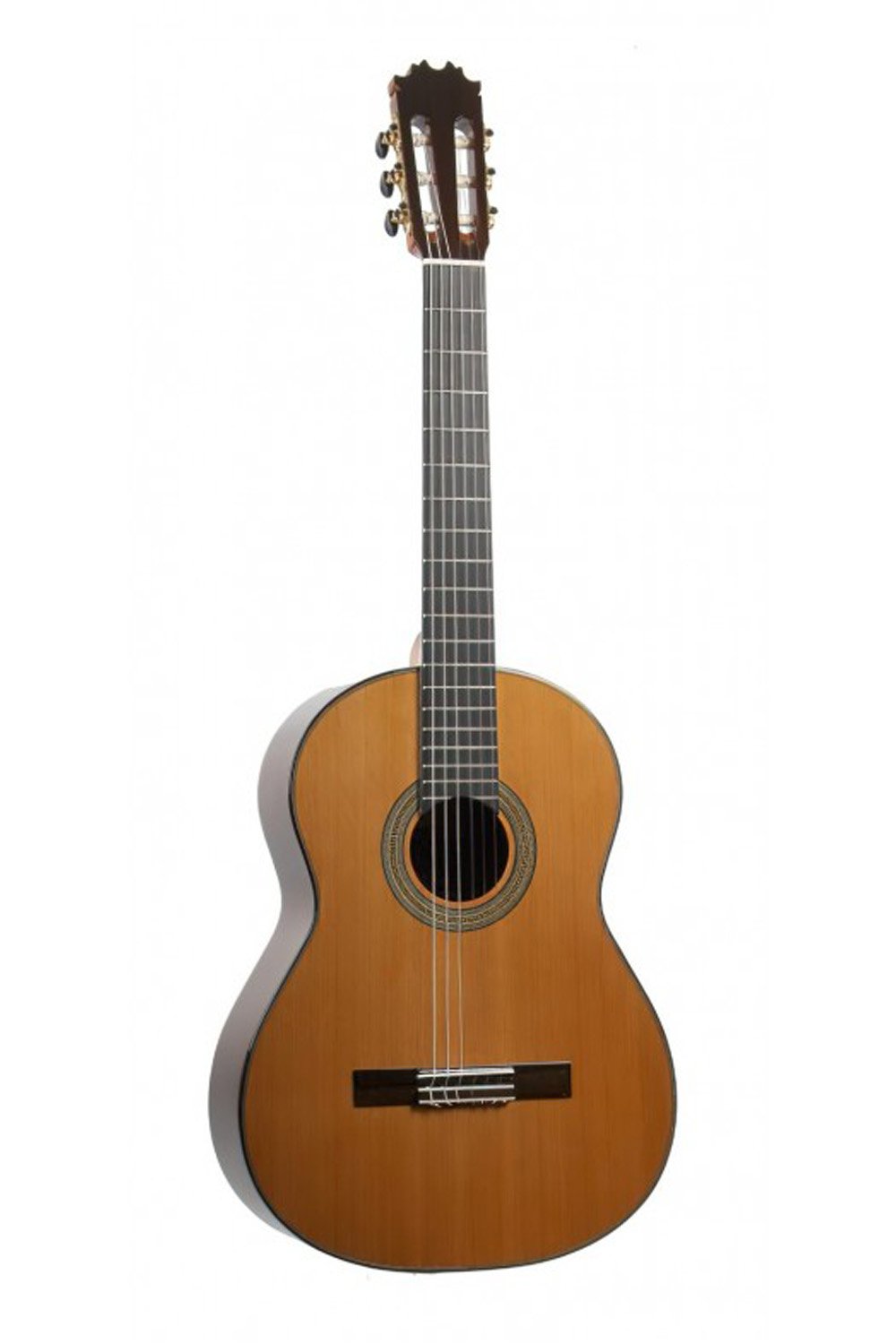
Priced at $1400, the Antonio de Toledo AT 15A is available with either a solid Cedar or Spruce top and features laminated Indian Rosewood back and sides.
This model comes in both Lattice and Fan Braced versions.
Daniel Nistico's review of the Lattice version highlighted its punchier sound compared to the fan-braced model, though he noted the fan-braced version had a more mellow and rounded tone.
He found both to be very playable and responsive to tonal and dynamic changes.
Enjoy a special 10% discount on all Antonio de Toledo guitars!
FEATURES
Available in Lattice Bracing or Fan Bracing
Top – Solid Cedar (or Spruce)
Neck - Cedar
Back and Sides – Laminated Indian Rosewood
Fingerboard - Ebony
Varnish - Natural resin lacquer
Bone nut and saddle
NOTES
The handcrafted Antonio de Toledo AT-15 offers outstanding performance, attractive appearance and high quality finishes, all at a very affordable price.
Available in lattice or fan bracing and full thickness quality Cedar or Spruce top, this guitar delivers power and projection, together with tone and projection way beyond what could be expected at this price range.
This hand-crafted guitar is the perfect companion for musicians looking for reliability and consistency in their instrument.
Antonio de Toledo Guitars
Authentic artisan jewels. Those 3 words are best define Antonio de Toledo Guitars, a company that has been offering high quality instruments for a long time at prices suitable for everyone.
In the catalog of this workshop, you can find Spanish guitars (classical and flamenco) made with the best materials on the market. Good sound, comfort and luxury finishes are the main characteristics that you will find if you buy a guitar from this brand.
Do you want to know more about Antonio de Toledo?
The Antonio de Toledo Guitar workshop was founded more than 10 years ago by a group of luthiers passionate about music and guitar construction. Since then, it has dedicated itself to hand-crafting high-quality guitars using only premium materials and traditional construction techniques.
The company has stood out for offering classical and flamenco guitars. Each one is designed and built in collaboration with expert guitarists to ensure it meets the highest quality levels.
This workshop has a very clear belief, which is that each guitar is a work of art that can inspire and transform whoever plays it. That's why they go to great lengths to provide high-quality guitars that can provide customers with years of satisfaction and musical enjoyment.
What does the Antonio de Toledo Guitars catalog offer us?
The Antonio de Toledo guitar catalog offers a wide variety of Spanish guitars made 100% by hand. This artisan firm is known especially for its flamenco guitars, as well as for its classical guitars and electrified models. In their catalog, you can find instruments for both beginners and professional musicians, as well as a variety of options that allow for customization.
The workshop, is headquartered are in Griñón (Madrid province) close to Toledo, is distinguished by excellence in the manufacturing of its guitars, which are handcrafted by highly qualified craftsmen. The company uses high quality materials, such as noble woods (such as Indian rosewood, Spanish cypress, etc.), to guarantee the best sound quality and durability in its instruments.
Among the guitars that we can find in the Antonio de Toledo's catalogue, we can highlight the flamenco guitars, whose manufacture usually makes use of woods such as solid German spruce, sycamore or cypress. These guitars have a characteristic sound, with a lower tuning than the classical guitar and a brighter, higher-pitched tone. In addition, they usually have a specific shape and design, with a smaller soundboard, a thinner neck and a lowered string height that facilitates the execution of the flamenco technique.
On the other hand, we can also find classical guitars. This instrument usually has a large, round soundboard, a wider neck, and a cedar or spruce top. These characteristics give them a warm and rich sound, which is well suited to the performance of classical pieces and other genres that require a smooth and detailed sound.
Why buy an Antonio de Toledo?
This artisan workshop has been manufacturing high-quality guitars for several years and putting special effort into making the price affordable for all budgets. Furthermore, as we have already mentioned, Antonio de Toledo guitars are 100% artisanal and this allows you to acquire a unique and exclusive instrument, since each model is different and has its own characteristics and details that make it unique.
In addition, these guitars are increasingly used in the professional field, since renowned artists such as Diego del Morao or Antonio Rey already use them in many of their performances. This is no coincidence, and the company has been able to fine-tune its manufacturing in an excellent way, in order to put in our hands Spanish guitars with outstanding features at a very reasonable price.

=> please CLICK HERE to see this guitar in action:
Priced at $1800, theAntonio de Toledo AT 19 Ziricote Latticefeatures a solid Cedar top with lattice bracing and striking Laminated Ziricote back and sides.
Daniel Nistico's review of this model highlighted its beautiful Ziricote wood, strong sound, and comfortable playability, especially in the higher register.
He found it to be very responsive with good sustain and a beautiful tone.
Remember your 10% Friends of GuitarsOnline discount!
Click here to view this guitar =>
Top: Solid cedar
Sides and back: Laminated Ziricote
Profiles: Wood
Fingerboard: Ebony
Neck: Cedar
Neck Reinforcement: Ebony
Bridge: Rosewood
Capo: Bone
Nut: Bone
Headstock: Der-jung professional
NOTES
Antonio de Toledo AT-19C is a semi-professional classical guitar with solid lattice braced cedar top and Laminated Ziricote for improved density and quality of tone. It delivers both power and projection and quality tone within an affordable student budget.
It has a wide box with powerful sound and great resonance and easy to play.
Antonio de Toledo Guitars
Authentic artisan jewels. Those 3 words are best define Antonio de Toledo Guitars, a company that has been offering high quality instruments for a long time at prices suitable for everyone.
In the catalog of this workshop, you can find Spanish guitars (classical and flamenco) made with the best materials on the market. Good sound, comfort and luxury finishes are the main characteristics that you will find if you buy a guitar from this brand.
Do you want to know more about Antonio de Toledo?
The Antonio de Toledo Guitar workshop was founded more than 10 years ago by a group of luthiers passionate about music and guitar construction. Since then, it has dedicated itself to hand-crafting high-quality guitars using only premium materials and traditional construction techniques.
The company has stood out for offering classical and flamenco guitars. Each one is designed and built in collaboration with expert guitarists to ensure it meets the highest quality levels.
This workshop has a very clear belief, which is that each guitar is a work of art that can inspire and transform whoever plays it. That's why they go to great lengths to provide high-quality guitars that can provide customers with years of satisfaction and musical enjoyment.
What does the Antonio de Toledo Guitars catalog offer us?
The Antonio de Toledo guitar catalog offers a wide variety of Spanish guitars made 100% by hand. This artisan firm is known especially for its flamenco guitars, as well as for its classical guitars and electrified models. In their catalog, you can find instruments for both beginners and professional musicians, as well as a variety of options that allow for customization.
The workshop, is headquartered are in Griñón (Madrid province) close to Toledo, is distinguished by excellence in the manufacturing of its guitars, which are handcrafted by highly qualified craftsmen. The company uses high quality materials, such as noble woods (such as Indian rosewood, Spanish cypress, etc.), to guarantee the best sound quality and durability in its instruments.
Among the guitars that we can find in the Antonio de Toledo's catalogue, we can highlight the flamenco guitars, whose manufacture usually makes use of woods such as solid German spruce, sycamore or cypress. These guitars have a characteristic sound, with a lower tuning than the classical guitar and a brighter, higher-pitched tone. In addition, they usually have a specific shape and design, with a smaller soundboard, a thinner neck and a lowered string height that facilitates the execution of the flamenco technique.
On the other hand, we can also find classical guitars. This instrument usually has a large, round soundboard, a wider neck, and a cedar or spruce top. These characteristics give them a warm and rich sound, which is well suited to the performance of classical pieces and other genres that require a smooth and detailed sound.
Why buy an Antonio de Toledo?
This artisan workshop has been manufacturing high-quality guitars for several years and putting special effort into making the price affordable for all budgets. Furthermore, as we have already mentioned, Antonio de Toledo guitars are 100% artisanal and this allows you to acquire a unique and exclusive instrument, since each model is different and has its own characteristics and details that make it unique.
In addition, these guitars are increasingly used in the professional field, since renowned artists such as Diego del Morao or Antonio Rey already use them in many of their performances. This is no coincidence, and the company has been able to fine-tune its manufacturing in an excellent way, in order to put in our hands Spanish guitars with outstanding features at a very reasonable price.
=> please CLICK HERE to see this guitar in action:
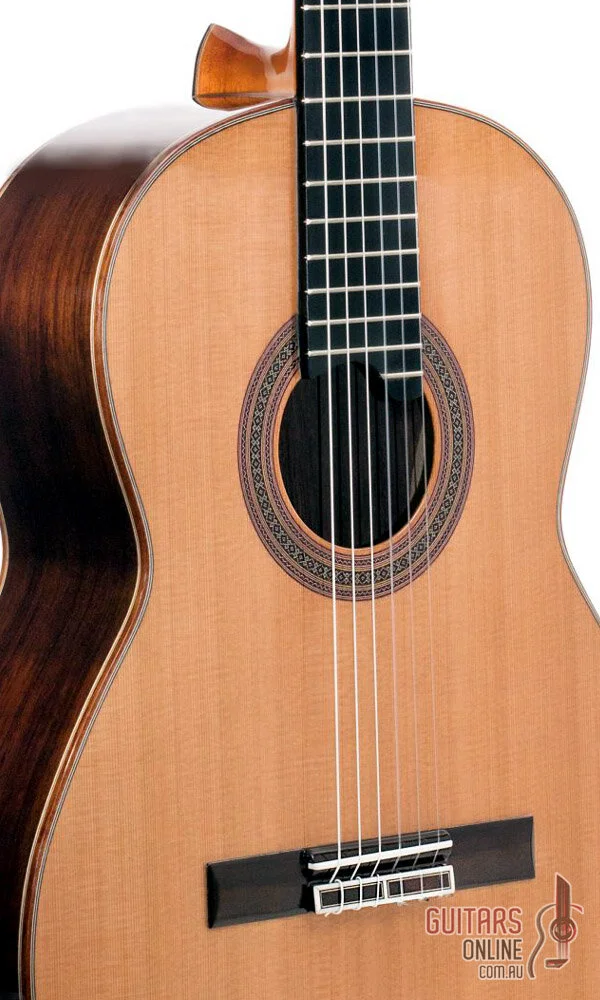
FEATURES
Top – Solid cedar, Lattice Bracing
Back and Sides – Solid Madagascar
Fingerboard - Ebony
Neck: Cedar with carbon fiber reinforcement
Bridge: Rosewood
Machineheads: MH-006 Golden with black pegs
Nut & Saddle: Bone
Finish: Gloss
Scale Length: 650 mm
Nut Width: 52mm
Body depth at upper bout: 96mm
Body depth at lower bout: 102mm
NOTES
Built with Lattice bracing, but keeping the sound with all the flavor and color of the best Spanish guitar.
The back and sides are made of Madagascar rosewood and it provides a very rich sound, full of colour and nuances.
It stands out due to it’s power and projection, its long sustain and its rich harmonics.
And it is a very comfortable and easy to play guitar.
One of the best guitars in this category and at an unbeatable price.
Condition Report
It is in as new condition and is a superb example of the Prudencio Saez workshop since it was hand-picked by a well-known player and collector for it’s colour and ease of play and tone.
Given it was one of many guitars in the collection it has seen little play.

=> please CLICK HERE to see this guitar in action:
FEATURES
Top – Solid Cedar
Neck - Cedar
Back and Sides – Indian Rosewood
Varnish - Natural resin lacquer
Scale – 650 mm
NOTES
Prudencio Saez model 2-M (G9) is a guitar with very good performance, all solid, with a rich and colourful sound, as well as very comfortable and easy-playing.
As usual in the guitars Prudencio Saez, it is a model with excellent price-quality-sound relationship.
The master luthiers have paid special attention to the action of this instrument, with the guitar student in mind, to ensure a wonderful playability.
The solid rosewood body and solid cedar top, produces a rich, well-balanced, professional sound, with great projection.
A beautiful finish and quality, all at an exceptional price.
We are actively seeking guitars from Australian Luthiers
If you have a hidden gem among your collection, and are interesting in adding it to our range, please contact Pierre on pierre@guitarsonline.com.au or m: 0410 708 338.
Recently Sold - Guitars from Australian Luthiers
- a unique selection of recently sold rare, vintage & premium classical concert guitars from Australian Luthiers -
Luthiers including: Allan Bull, Andrew Doriean, Cary Pedicini, Dan Kellaway, Daniel De Jong, David Argent, George Ziata, Gerard Gilet, Graham Caldersmith, Greg Smallman, Jayson Elazzi, Jeff Kemp, Jim Redgate, John Price, Paul Sheridan, Richard Howell, Rob Clarke

=> please CLICK HERE to see this guitar in action:
Juan Alexander Grupalli - His work in his own words
Started making guitars in 1995 with Joaquin García in Spain.
Joaquin is my stepfather. He taught me how to build his model of guitar that has a very traditional construction. Everything is made from scratch using selected woods that have been drying for decades. The glue I use is hot glue (hide glue)
For the varnish, only shellac diluted in pure alcohol and a tiny bit of linseed oil is used to apply very thin layers of varnish to the surfaces of the guitar. This kind of varnish is known as French polish and is known to help project sound.
The neck of the guitar is attached to the sides using two wooden wedges inside the guitar that lock the parts together. This technique is also used by other guitarmakers such as José Romanillos.
The rosettes of my guitars are designed and made by myself using very thin pieces of wood inlaid around the sound hole.
I have made many guitars out of European spruce (for the soundboard) and prefer this material as it has been used for musical instruments (such as pianos, violins and guitars) for centuries and has proven its longevity. I have also made guitars with Western red cedar soundboards with good success. The spruce I use is always European rather than Engleman spruce or Douglas spruce (From North America) The cedar sounboards come from North America.
When I make a guitar, I select the wood myself and shape it according to the sound it makes when I tap it with my fingers. Once the guitar is made I play it for some time and if necessary I will tune the top or the back to a lower tone by removing some shavings of wood from some of the internal struts.
I believe that the design of the modern classical guitar has reached its maximum perfection with the work of such makers as Torres, Hauser, Fleta and many others. I enjoy building guitars inspired in the designs of such masters.
I do not believe that it is necessary to add a device to amplify the sound of the classical guitar into the instrument itself as this seems to be in detriment of the quality of the sound. The guitar might sound louder but not as nice. By using good quality microphones placed away from the guitar and good quality equipment the sound can be amplified if necessary (to play with an orchestra for example)
I have studied guitar making with several makers: Joaquin García (Spain), Stephen Hill (UK), Fernando Silva (Argentina), James Lister (UK), Andrew Armstrong (Australia)
Price on Application
=> please CLICK HERE to see this guitar in action:
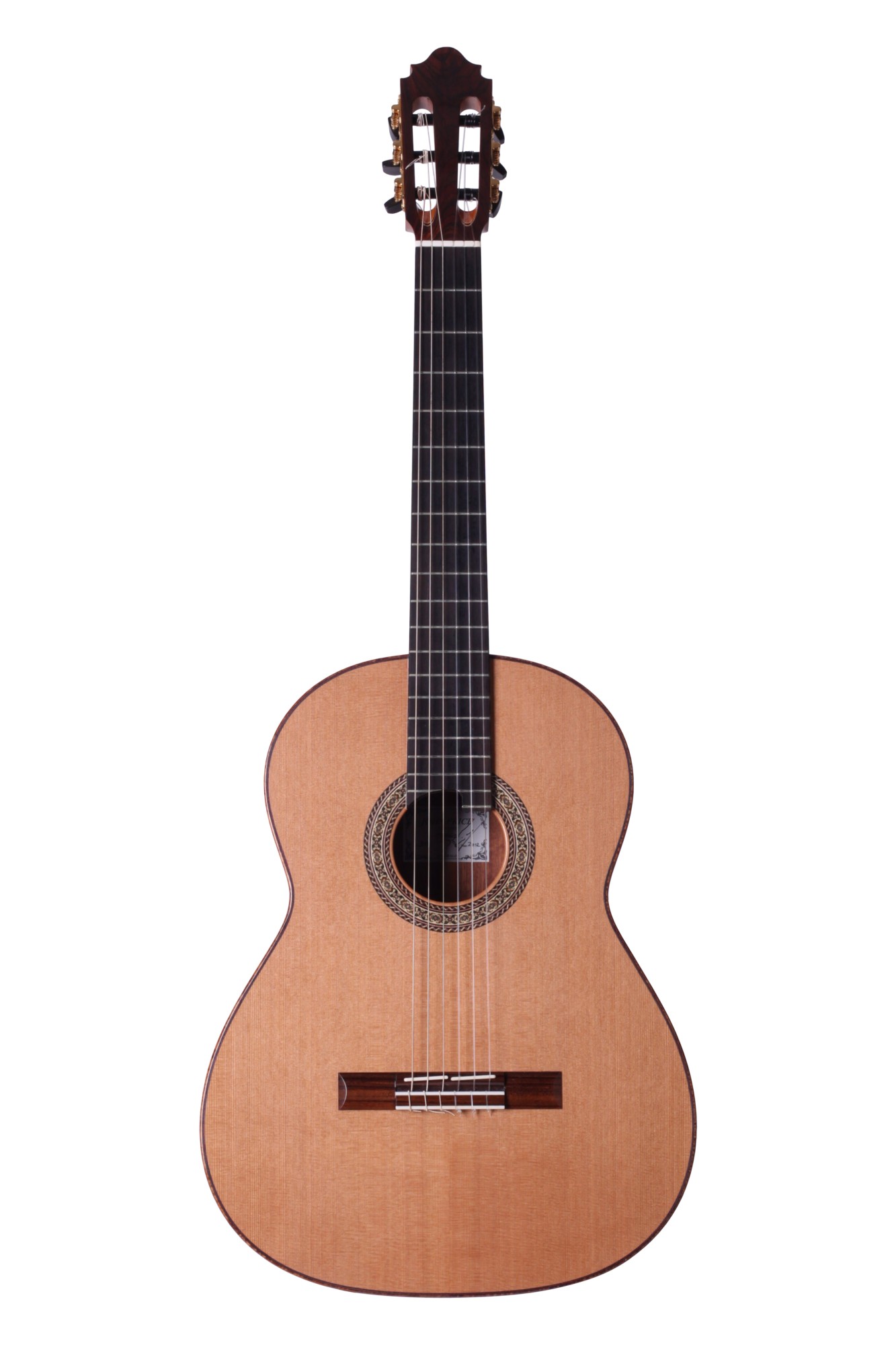
2012 John Price Lattice ($6,000) in as new condition (new price $10,000)
In John's words ... "Utilising both musicianship and cabinet making skills, I take an intuitive approach when designing and building these instruments.
My unique approach to the construction of the soundboard and the lattice that supports it greatly enhance the volume, tonal range and flexibility of nuance required in the modern style of guitar.
By coupling this type of soundboard with an arched, braceless back, sustain and projection are also greatly enhanced."
Features:
Offering a wonderful even tone and astounding resonance, the guitar has sung in concert halls around Australia, and overseas in Vietnam, Mallorca, New Zealand, Austria and Italy. Lattice-braced Cedar soundboard
Arched rosewood back
650mm scale ebony fingerboard with extra 20th fret high ‘C’
High quality tuners with Ebony buttons.
Description:
This is one of the few second hand John Price guitars to come into the market over the last 15 years.
It is as new since the current owner has a number of guitars.
It plays beautifully with excellent volume and tonal range with beauty in the note.
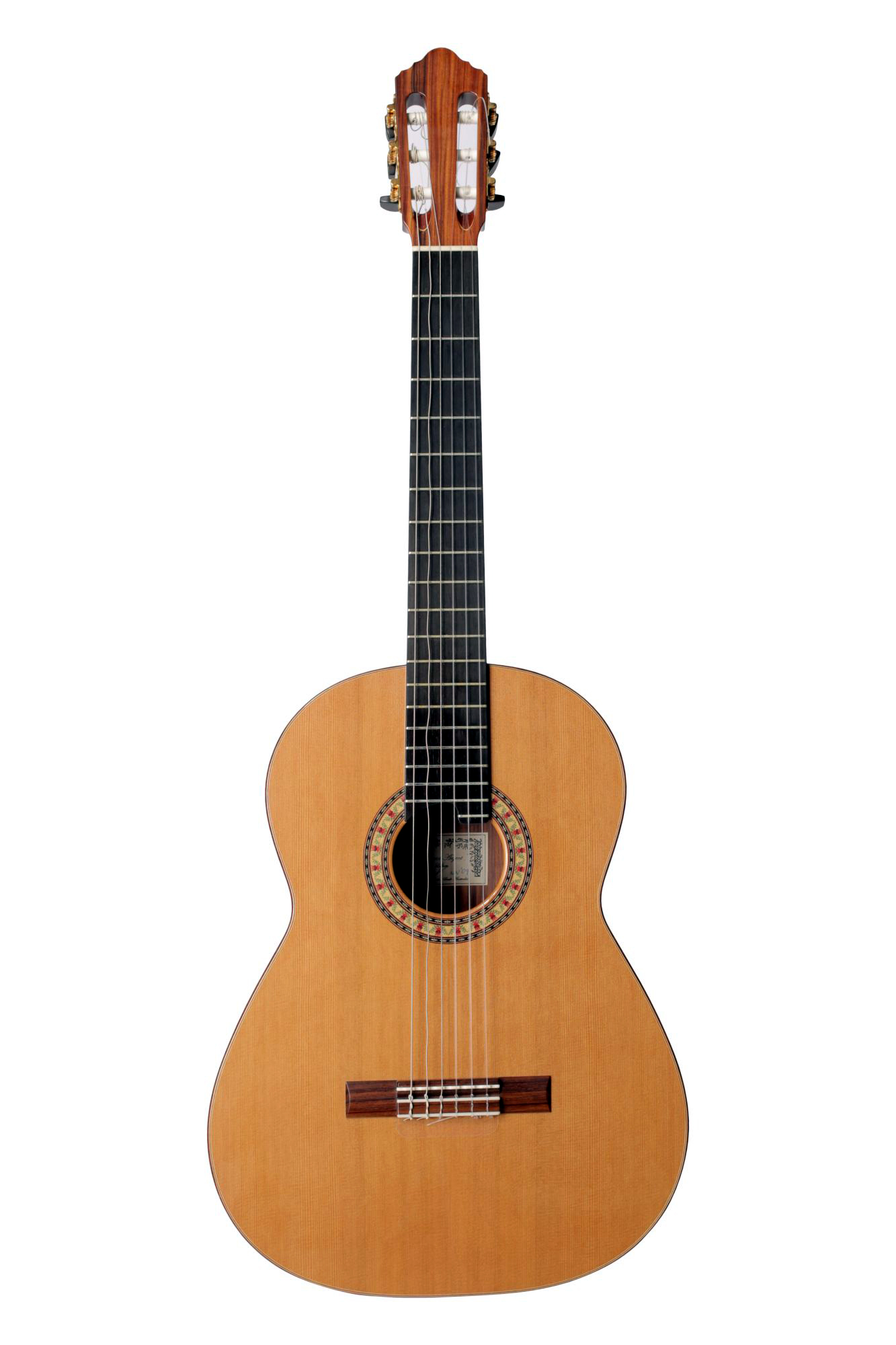
This is a Nov 2009 Concert Guitar Cedar top built by South Australian luthier David Argent who apprenticed under John Price. It is in great condition with great projection and colour. David is also a player which is reflected in the neck profile of this guitar leading to superb ease of playing.
It is very easy to play and it is easy to see why he has found so much success internationally. It is also one of the very few examples to come onto the market since he is no longer active due health concerns.
- Scale 650 mm
- Bracing: Lattice
- Back and Sides: Rosewood with arched back
- Finish: French Polish with laquer back and sides, 20th Fret
- Condition: as new
- Case: Hiscox

=> please CLICK HERE to see this guitar in action:
2013 Dan Kellaway Lattice Concert Spruce top and Brazilian Walnut back and sides + Case
Features
Year of construction: 2015
Scale length (mm): 650mm
Top: Englemann spruce
Back/Sides: Brazilian walnut
Neck/Fingerboard: mahogany with ebony fingerboard.
Sound: A balanced, sweet guitar with remarkable volume, power and dynamics for a traditional instrument.
Here are the comments of Dan Kellaway regarding his Dan kellway lattice classical guitars :
“My Lattice braced classical guitar has evolved over two decades to arrive at a significant stage of development.
It is made using only traditional timber but follows many ideas developed by the best modern Australian makers.
No balsa or carbon fibre are used in this construction. I also attempt to limit the weight while still utilizing the molded back and other enhancements.
Engelman’s Spruce is used because it is midway between European Spruce and Western Red Cedar in hardness , strength and tonal qualities.
My aim here is to provide a middle ground between Smallman and Marty with a very sweet tone in a loud full blown concert instrument.
Here is the ultimate lattice braced full bodied Concert Guitar.
This lattice contains no carbon fibre but is instead reinforced where required with cloth tape soaked in glue.
There is no balsa wood used inside this instrument.
The bracing material is the same as the soundboard itself. This uniformity of timber is more sonorous than a mix and provides great clarity and focus on the note.”
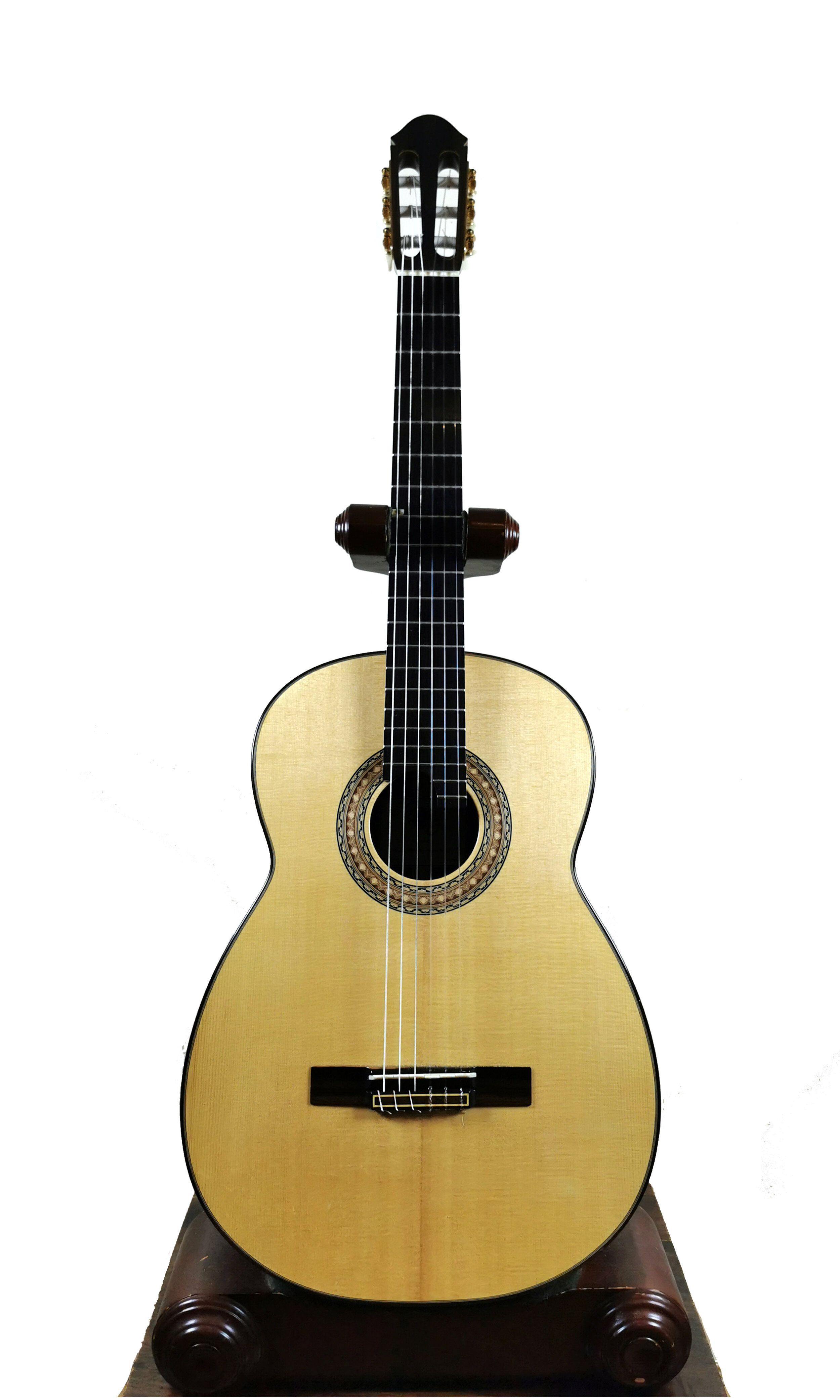
=> please CLICK HERE to see this guitar in action:
2009 Allan Bull Lattice (new price $4,600)
Scale – 650
Top - Engelmann Spruce
Back and Sides – Sassafras
Fret board – Solid Ebony
Machine heads – Gold
Tuners - Gotoh
Neck width 53mm
Condition: As new
Standard concert guitar features.
The lightweight soundboard is braced in an asymmetrical grid layout for responsiveness and evenness of support across the guitar's range with high structural integrity.
Standard thickness back and sides are reinforced with additional laminations and the back is arched and braceless. The light weight, compliant soundboard is joined to the rigid sides and back with solid quarter linings to maximise sustain and projection.
The neck is slim and is profiled for ease of playing. The shaft is supported by the neck block/cradle which extends to the first transverse brace for neck joint rigidity.
The length of each string is individually compensated at both nut and saddle to counter the effects of fretting and travel stretch and ensure accurate intonation on all strings at all points of the scale.
The fretboard is elevated above the soundboard to provide improved access to the frets beyond the body join.
The armrest removes the damping effect of the forearm on the soundboard and aids player comfort.
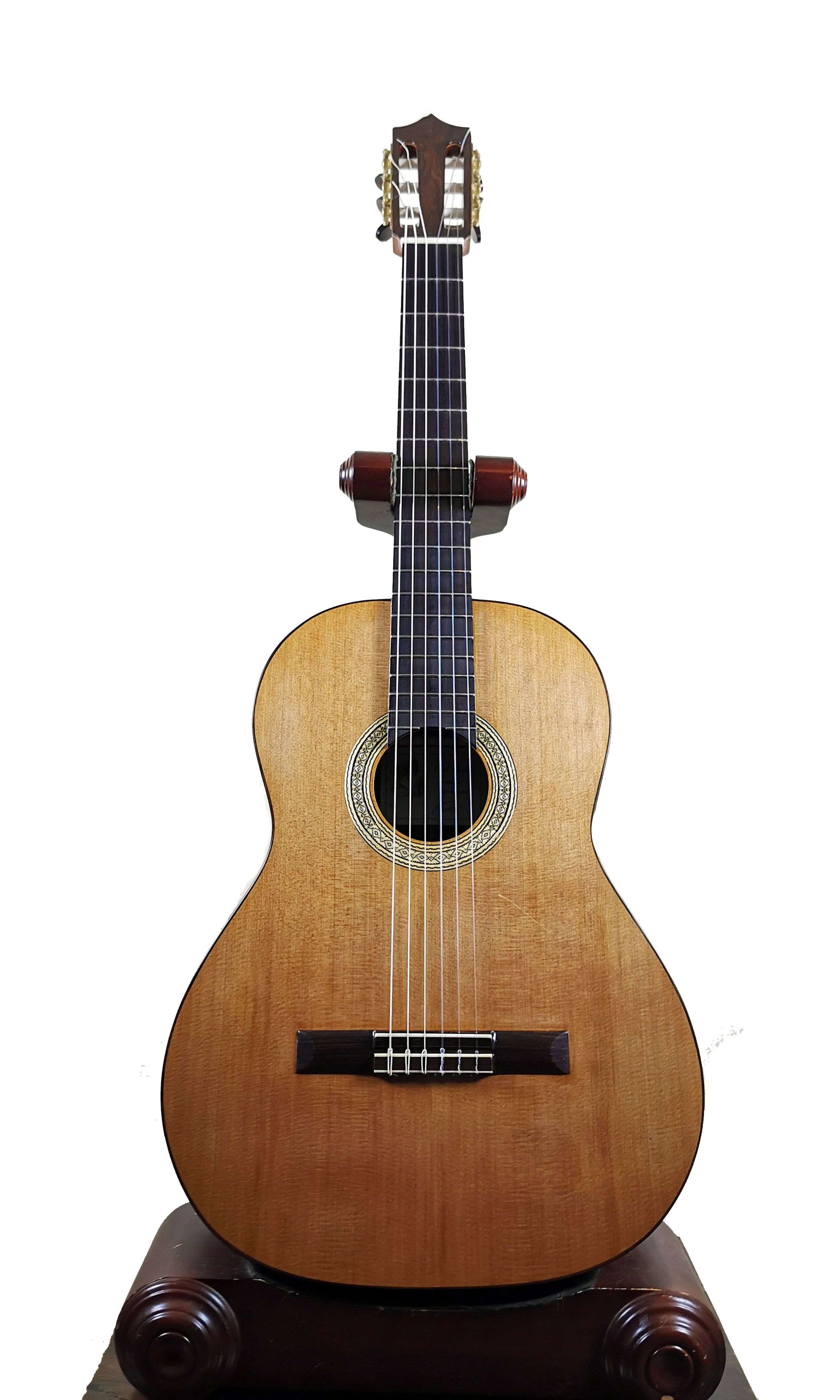
A South Australian Maker building in the traditional style delivering very accomplished guitars and still at very reasonable prices. This example plays very well and is in excellent condition.
- Top: Cedar
- Scale: 650 scale length
- Blackwood body,
- Ebony finger board.
- Traditional build, 7 fan struts, individual tentolones
- Schaller HG tuners.
- Indian rosewood bridge
- Bone nut & bridge piece.
- Finish all lacquer.

The purpose of the guitar was to provide a top quality instrument with the best woods but in the same size and shape and fretboard width as a classical instrument.
In this way, it was ideal for a classical guitarist to switch without difficulty to play some classical/fingerstyle pieces which can really sound lovely on a good steel string instrument.
Features
Top: Cedar
Back/Sides: Brazillian Rosewood
Bracing: Lattice
Scale: 640 mm
Description:
A very full and resonant guitar delivering all the brightness of steel string - and with the fullness and purity of the note and resonance of a classical guitar.

Features
Top: Cedar
Back/Sides: Brazillian Rosewood
Bracing: Lattice
Scale: 640 mm
Description:
It plays well and is loud and tonally exceptionally rich, playable and you can easily bring out the treble lines with no effort. The 640 is an appealing scale to many players looking for that lattice sound and projection.
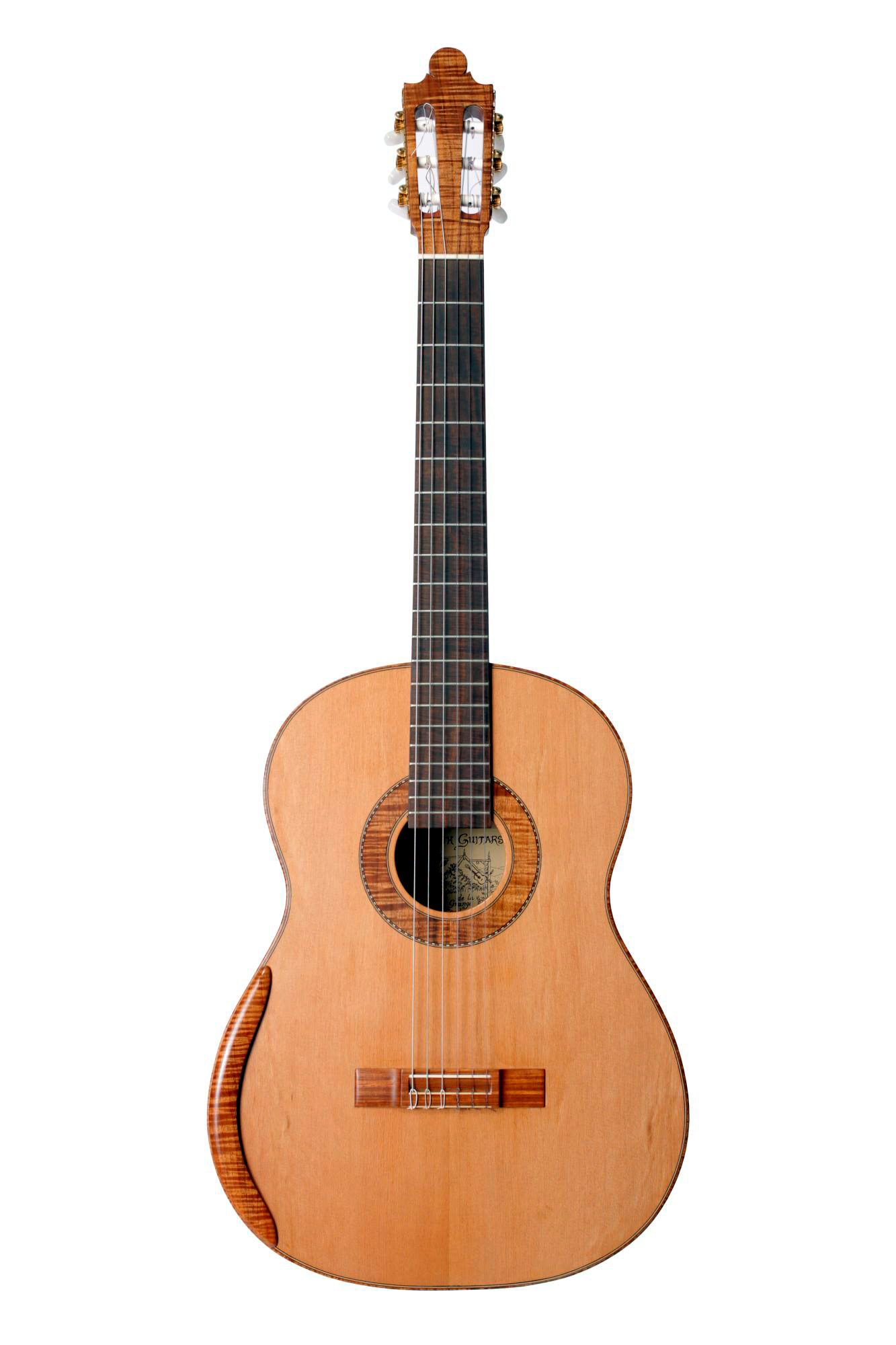
For the first time in years, I have just welcomed back into the showroom a beautiful Concert Caldersmith (No 65) I sold to its owner in 2011. It is still in the same excellent condition as when I sold it then.
I remember I sold it then for $7500. And I have persuaded the seller to list at $5,700 so it is a bargain considering you can not buy them new since sadly Graham passed away and they now have cult status.
Graham was He leaves a rich legacy of many 6 string children and a generation of Australian Players
Australian guitar makers have achieved global recognition for their pioneer work with carbon fibre/balsa lattice guitars since the early 1980’s. As one of these pioneer luthiers, Graham’s work is guided by his Physics background and knowledge of acoustics.
Traditionally, guitar makers have endeavoured to optimise the vibration of the back and sides as well the top of the guitar. This means that some of the plucked string energy is lost from the vibrating soundboard to the back and sides. The ‘new’ Australian guitar method builds strong and stiff back and sides and a very thin top/soundboard. In this way, the string energy is translated into sound which carries into the audience rather than much of it being depleted into the player’s body.
The carbon fibre/balsa lattice is an effective way of stiffening the soundboard and so allowing it to be as light and efficient as possible.
A Caldersmith Concert Guitar features the following attributes
The guitar is made on a strong 17mm marine ply frame.
1mm thick western red cedar soundboard reinforced with a graded rectangular balsa/carbon fibre lattice.
Laminated curved back increases strength and gives a lower resonance density, taking less vibration away from the soundboard.
Double acting truss rod allows accurate regulation of neck curvature.
Superior machine heads.
20 frets.
Armrest (optional).
Concert guitars are supplied with a light, but strong Hiscox case for greater protection during air travel.

These guitars maintain the quality features of Caldersmith guitars, whilst keeping the non-professional player (and their budget) in mind. All tops are made from Western Red Cedar or King William Pine incorporating rosettes in the original Caldersmith style. The soundboard is reinforced with a graded rectangular lattice of western red cedar instead of balsa/carbon fibre. This gives a somewhat different sound from the carbon fibre guitars while retaining good projection and sustain.Other features of the ‘Grange’ guitars include :
- Lighter 15mm ply frame.
- 1.5mm thick soundboard.
- Double acting Truss Rod.
- Tapered fingerboard to the bass side.
- Lightweight backpack or normal ply case.
- The grange design has also proven particularly effective for the higher range treble and octave guitars.
Features
- Scale – 650
- Top – Solid Cedar
- Back and Sides – Various on request
- Fret board – Solid Ebony
- Machine heads – Gold
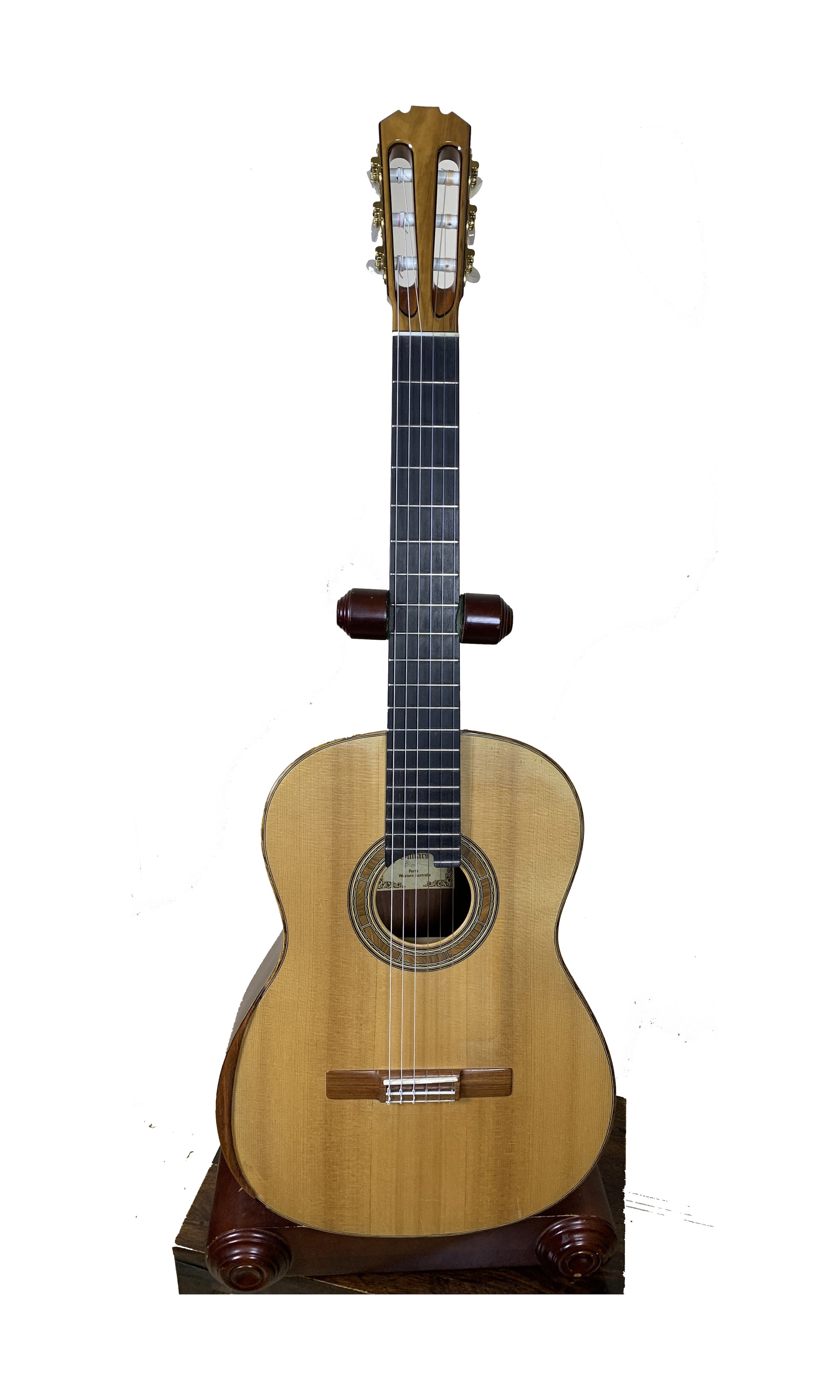
A very Rare Paul Sheridan guitar has just arrived.
The best guitar to come through the showroom this year.
It is 2000 Paul Sheridan Spruce top Jarrah back and sides No 133.
It is in original condition and plays superbly as the demos we just recorded show.
As the videos reveal, its voice is both sweet and lyrical and loud and orchestral delivering with clarity and poise and perfect articulation.
It features an armrest added by Sachar Amos under instruction by Paul Sheridan in 2020.
This guitar is in original condition with no repairs.
It comes with its's original $1500 Presto Case and features String Savarez HT Classics.
This guitar will be on everybody's Christmas wish list this year but it will be under the tree of only one quick acting player.

=> please CLICK HERE to see this guitar in action:
- Price on Application -
Description:
This 1998 Greg Smallman Guitar is one of the last instruments crafted solely by Greg Smallman and one of the last to have Greg Smallman’s name without his sons recognition on the label.
A beautiful musical instrument, it has been in its original owners loving hands since purchase.
It maintains excellent condition, with a recent reconditioned top and re-fret by master-craftsman Teen Goh.
Features:
Top: Cedar
Bracing: Lattice
Back and Sides: Brazilian Rosewood
Tunners: Schaller
The case is the big Wooden cases that Smallman himself hand built in the 90’s to protect his guitars before transitioning to commercially built cases
Condition Report:
Offering a wonderful even tone and astounding resonance, the guitar has sung in concert halls around Australia, and overseas in Vietnam, Mallorca, New Zealand, Austria and Italy.
It’s voice has weaved through the internationally acclaimed Australian guitar quartet, Guitar Trek.
The professionally trained owner attests to its glorious versatility of tone and texture, appreciating its beauty performing music ranging from renaissance works by Dowland and Batchelor, Bach’s Lute and Cello suites, the quintessential Albeniz and Granados works, to contemporary English and Australian works by Walton, Berkeley and Houghton.
Price on Application
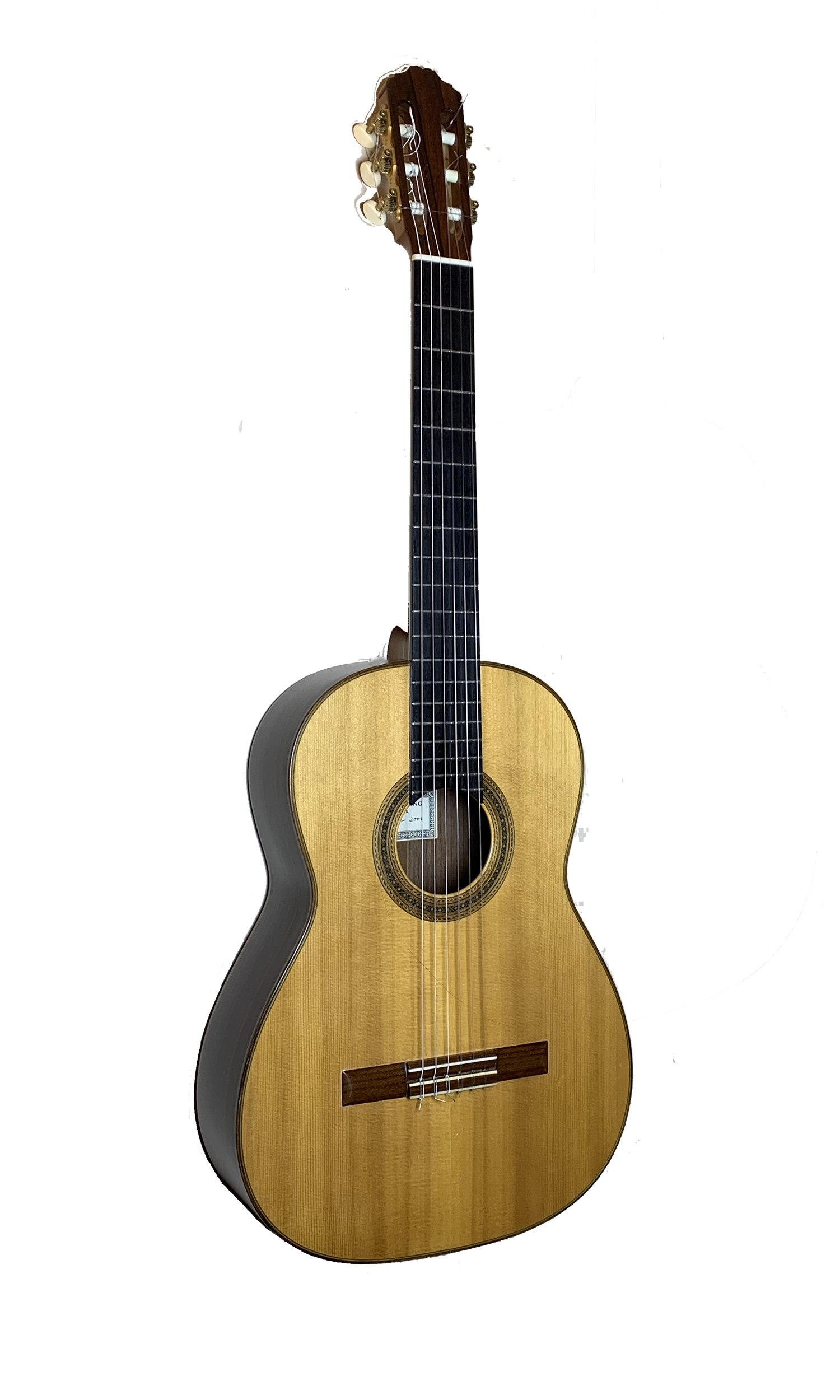
Daniel De Jong is a Tasmanian luthier building guitars in the traditional Spanish style.
Torres, Hauser, Santos Hernandez and Jose Romanillos are his prime influencers.
Specs
650 Scale
French Polished
Tuners - machine heads
Hiscox case
Price $4,900
Condition – Superb with one very careful and fastidious owner.

Recently Made instrument featuring the latest Rossette design
Using some of very Richards’s Best tone wood
It is a thing of beauty, taste, and discernment.
Here is a great Richard Howell Fleta’s inspired model guitar including case.
Richard Howell is a famous builder who extensively made Fleta replicas inspired by the late Fleta guitar.
The craftsmanship is amazing and the sound warm and powerful.
The sound remains magical and the playability is simply perfect.
This stunning guitar is hand finished (French polished), in the traditional manner using a variety of carefully selected gums and shellac.
FEATURES
Top: Cedar
Back and Sides: Indian rosewood (40 years old+)
Finish: French Polish
Condition Report.
It is in in excellent condition with no cracks or repairs with only minor wear from nail wear on the delicate French polish which are hardly visible.
The left-hand action is easy and relaxed and the right playing is responsive the sound is rich, warm and powerful with resonant base notes and clear ringing trebles.
Richard Howell’s waiting list is now 2-3 years, and his output has slowed to a trickle due to health reasons, so his prices have doubled; here is an opportunity to play and find a bargain without the wait.
Currently, I also have a 2017 Richar Howell in Spruce, so you have a rare opportunity to compare Cedar and Spruce versions of the similar vintage.
Introduction Richard Howell’s website – Hand Crafted Classical Guitars
I was born in Surrey England and music has been a big part of my life since early childhood. My father was a musical director in London, and together with his orchestra handled most of the big stage shows, therefore I was always exposed to music and musicians of the highest quality.
It was at this time that I first fell in love with the guitar, and remember pestering my parents to buy me one, which they duly did when I was about ten.
I made my first guitar in 1966, but it was not until I moved to Australia in 1972 and met Jason Waldron, the proprietor of the Adelaide Spanish guitar centre, that I started to take making seriously. Jason was looking for someone to make student model guitars and somehow I convinced him I was the man for the job.
During this period I had the opportunity to study the work of many of the world’s finest guitar makers. Fleta, Hauser, Hernandez y Aguado, to name but three.
I was particularly inspired by the guitars of the late Ignacio Fleta, and spent some years studying his work.
When I come to make a classical guitar I aim to make an instrument that maintains the consistent qualities that characterise my guitars . (Adequate volume along with great separation, balance, and clarity, with a full and rich sound.) This is important as I am varying my instruments to suit the specifications of each guitar player, which undoubtedly is one of the chief advantages of acquiring a hand made instrument. It is the way to get the guitar suited to you.
My guitars have often been compared to Fleta’s and while I acknowledge the compliment, these days I do not copy them any more than any other maker’s work. I believe all Luthiers share a debt to others for refining the design and establishing benchmarks that we all try to meet or exceed. I try to build the very best sounding and playing instrument I can, and look to learn from any luthier and player who has understood wood and sound.
I work alone in a small workshop at the back of my house in Mornington, Victoria, building instruments one at a time for the most part, and use traditional hand tools and finishes for a vast majority of the work. My years of experience and experimentation together with a commitment to working entirely by hand has given me a good understanding of what each piece of tone wood has to offer. Every piece of wood is unique and I search for the best out of each. This allows me to produce guitars that fulfil the individual potential of the woods, while offering to each player something which is both appealing and at the same time challenging.
I have made over 400 guitars this way, and each one leaves my shop with a very good pedigree – the best materials I can find and all I know goes into each and every one. My preference for handcrafting instruments stems from my admiration and study of the great makers. It has, however, been equally important for me to create instruments which will compliment current demands in taste and performance, both for the professional and enthusiast.

=> please CLICK HERE to see this guitar in action:
A very special guitar has just come into the showroom!
It is a thing of beauty, taste, and discernment.
Here is a great Richard Howell Fleta’s inspired model guitar including case.
Richard Howell is a famous builder who extensively made Fleta replicas inspired by the late Fleta guitar.
The craftsmanship is amazing and the sound warm and powerful.
The sound remains magical and the playability is simply perfect.
This stunning guitar is hand finished (French polished), in the traditional manner using a variety of carefully selected gums and shellac.
FEATURES
Top: Cedar
Back and Sides: Indian rosewood (40 years old+)
Finish: French Polish
Tuning Pegs: Alessi ball bearing tuning pegs especially fitted ($600)
includes case
Introduction Richard Howell’s website – Hand Crafted Classical Guitars
I was born in Surrey England and music has been a big part of my life since early childhood. My father was a musical director in London, and together with his orchestra handled most of the big stage shows, therefore I was always exposed to music and musicians of the highest quality.
It was at this time that I first fell in love with the guitar, and remember pestering my parents to buy me one, which they duly did when I was about ten.
I made my first guitar in 1966, but it was not until I moved to Australia in 1972 and met Jason Waldron, the proprietor of the Adelaide Spanish guitar centre, that I started to take making seriously. Jason was looking for someone to make student model guitars and somehow I convinced him I was the man for the job.
During this period I had the opportunity to study the work of many of the world’s finest guitar makers. Fleta, Hauser, Hernandez y Aguado, to name but three.
I was particularly inspired by the guitars of the late Ignacio Fleta, and spent some years studying his work.
When I come to make a classical guitar I aim to make an instrument that maintains the consistent qualities that characterise my guitars . (Adequate volume along with great separation, balance, and clarity, with a full and rich sound.) This is important as I am varying my instruments to suit the specifications of each guitar player, which undoubtedly is one of the chief advantages of acquiring a hand made instrument. It is the way to get the guitar suited to you.
My guitars have often been compared to Fleta’s and while I acknowledge the compliment, these days I do not copy them any more than any other maker’s work. I believe all Luthiers share a debt to others for refining the design and establishing benchmarks that we all try to meet or exceed. I try to build the very best sounding and playing instrument I can, and look to learn from any luthier and player who has understood wood and sound.
I work alone in a small workshop at the back of my house in Mornington, Victoria, building instruments one at a time for the most part, and use traditional hand tools and finishes for a vast majority of the work. My years of experience and experimentation together with a commitment to working entirely by hand has given me a good understanding of what each piece of tone wood has to offer. Every piece of wood is unique and I search for the best out of each. This allows me to produce guitars that fulfil the individual potential of the woods, while offering to each player something which is both appealing and at the same time challenging.
I have made over 400 guitars this way, and each one leaves my shop with a very good pedigree – the best materials I can find and all I know goes into each and every one. My preference for handcrafting instruments stems from my admiration and study of the great makers. It has, however, been equally important for me to create instruments which will compliment current demands in taste and performance, both for the professional and enthusiast.

=> please CLICK HERE to see this guitar in action:
A very special guitar has just come into the showroom!
It is a 2018 Richard Howell copy of the famous 1824 Panormo (strung with Nail Gut).
It features a slightly curved fretboard to facilitate playing as per some Panormo originals
This Panormo is No 486 in 630 scale made by Richard Howell as a special commission for a well-known guitar identity.
www.howellguitars.com/guitar-models/panormo-model
It is a thing of beauty, taste, and discernment, just the thing for the gentleman that has if all guitar wise but still feels something missing to feel complete.
This my friend is the ultimate Christmas present!
It is here awaiting an eager player wanting to explore the early guitar music repertoire on and authentic period instrument with accurate response and modern playability.
FEATURES
The Panormo is a copy of an 1824 Louis Panormo
with a top and back and sides.Top –European Spruce
Back and Sides – Flamed Maple
Scale Length: 630 mm
NOTE - the images are of the actual guitar, taken during construction.

Literally just arrived in our showroom! This was a special-commissioned guitar built for a high- end player and collector.
The 2010 Redgate is a Cedar double top.
There are a few playing marks on the table, and the finish on the neck from frets 9 – 12 is beginning to show signs of wear. These have been photographed to show condition and are merely cosmetic.
This Cedar top is a great example of Jim Redgate’s work shows great sustain, clarity and articulation and is extremely well set up.
No expense has been spared and in terms of add-ons this guitar it has Sheller tuners fitted during construction and is presented in a $1200 Karura case.
Considering the current waiting list of four years for a Redgate the $12,000 asking price is very reasonable
To put it simply: This is an excellent guitar, delivers power, projection and purity in every note. You owe it to yourself as a guitarist to experience this guitar.
Features
650mm string length.
Fingerboard width: 53mm at nut.
Double Cedar top
Back and Sides: Brazillian Rosewood. Rodriguez ‘Church door’ style.
Arch Back
Elevated finger-board
French polished top
Tuners: Sheller from Germany
Case: Karura.
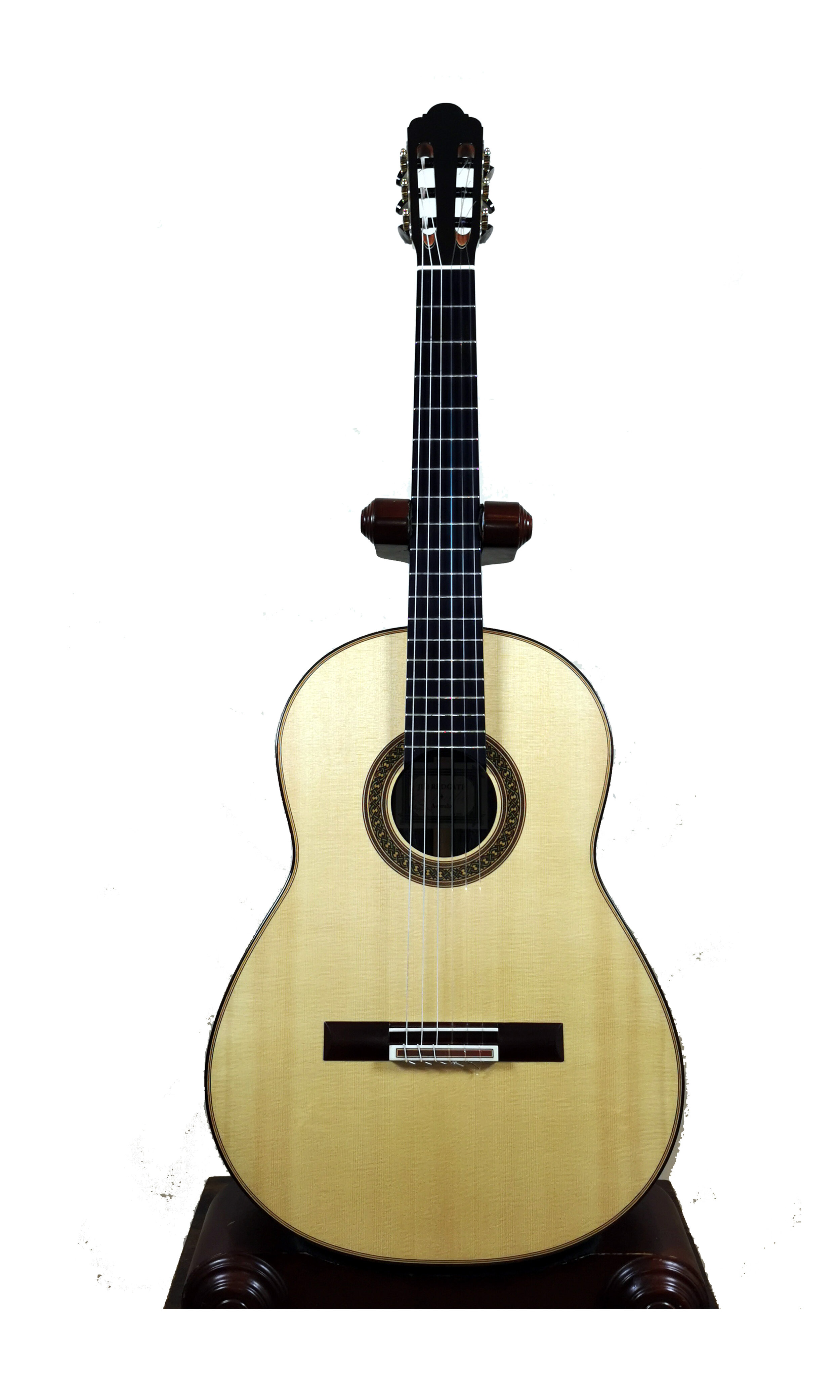
Literally just arrived in our showroom! This was a special-commissioned guitar built for a high- end player and collector to join his 2010 Jim Redgate Cedar.
The 2012 Redgate I have currently for sale is a Double featuring Spruce/Cedar double top the idea is that it delivers the best of both tonal woods.
It is in mint condition and is a great example of Jim Redgate’s work and when the current owner bought it through Jim Redgate’s authorised world-wide agent Chris Kamen he paid $20,000.00.
No expense has been spared and in terms of add-ons this guitar also had the Deluxe Rogers tuners fitted during construction that adds a $1000 to the cost and a $1200 Karura case.
After much soul-searching we have arrived at a more reasonable $12,000
To put it simply: This is an excellent guitar, delivers power, projection and purity in every note. You owe it to yourself as a guitarist to experience this guitar.
Features
650mm string length.
Fingerboard width: 53mm at nut.
Spruce/Cedar top
Back and Sides: Brazillian Rosewood. Rodriguez ‘Church door’ style.
Arch Back
Elevated finger-board
French polished top
Tuners: Rodgers Sheller from Germany
Case: Karura.
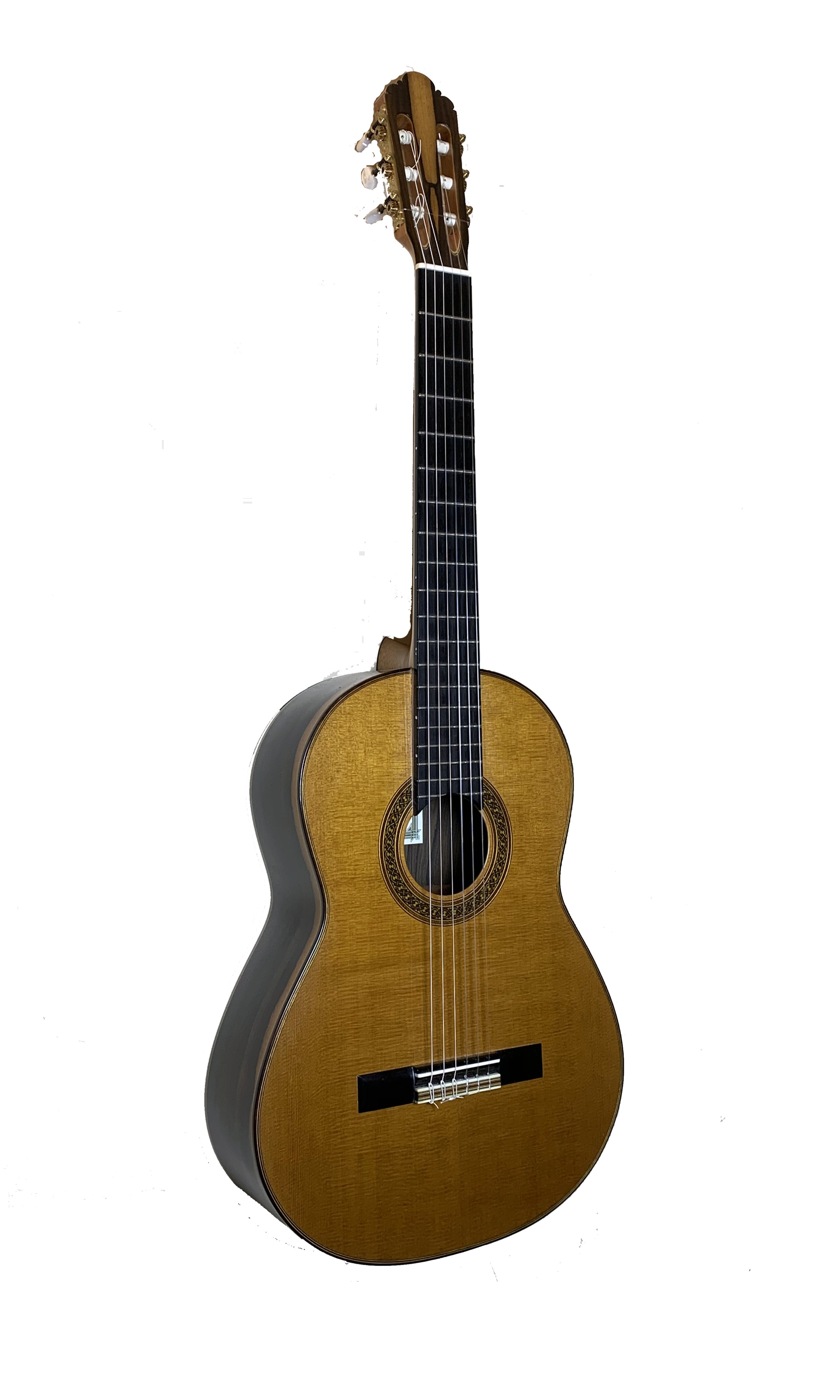
Literally just arrived in our showroom! This was a special-commissioned guitar built for a high end player and collector, exactly patterned on the Redgate Slava Grigoryan plays.
To put it simply: This is an excellent guitar, delivers power, projection and purity in every note. You owe it to yourself as a guitarist to experience this guitar.
Features
660mm string length.
Fingerboard width: 53mm at nut.
Cedar top
Back and Sides: Ziricote and Sap wood. Rodriguez ‘Church door’ style.
Dots on side of finger-board
Elevated finger-board
French polished top
Tuners: Sheller from Germany
Case: Hiscox.

=> please CLICK HERE to see this guitar in action:
Description: 2021 Jayson Elazzi Concert
Jason Elazzi a leading exponent in Australia of building in the traditional Hauser style.
Delivering a light and vibrant guitar that is tonally rich and very easy to play since they are so well set up.
His guitars over the years just keep on getting better and better. This spruce top shows superb clarity and evenness and the beauty of spruce shine through in each note.
FEATURES
Scale 650
Top: French polished Spruce
Back and Sides Indian Rosewood
Fretboard Ebony
Spanish fan bracing
Finish: French Polish
Condition New

Canadian Western Red Cedar top with asymmetrical 9 fan bracing system
- Indian Rosewood back and sides
- Calantis neck with Ebony fingerboard
- Indian Rosewood bridge
- Gotoh tuners as standard
- French Polish finish
Ihttps://www.pediciniguitars.com.au/
Exploring Australia's Finest Classical Guitar Luthiers: Characteristics and Masterpieces
Australia is celebrated for its innovative and highly skilled classical guitar luthiers who have redefined the art of guitar-making on the global stage. Combining traditional craftsmanship with groundbreaking techniques, Australian luthiers are renowned for creating instruments that offer exceptional tonal qualities, projection, and playability. In this article, we explore some of the leading Australian classical guitar luthiers, their unique approaches, and the defining characteristics of Australian classical guitars.
Key Characteristics of Australian Classical Guitars
Australian classical guitars are distinguished by several notable features:
Lattice Bracing: This innovative bracing technique, pioneered by Greg Smallman, increases the guitar's power and projection without sacrificing tonal quality.
Double Tops: Many luthiers utilize this construction method to enhance responsiveness and sustain, providing players with a more dynamic range.
Sustainability: A focus on using sustainable and alternative materials ensures durability and eco-friendliness.
Unique Aesthetics: Australian guitars often feature striking designs, intricate inlays, and premium woods, reflecting a high level of craftsmanship.
Playability: Instruments are designed with ergonomic considerations, making them comfortable for extended performances.
Renowned Australian Classical Guitar Luthiers
1. Greg Smallman
Specialty: Pioneer of lattice-braced guitars.
Characteristics: Renowned for powerful projection, exceptional sustain, and rich tonal depth.
Notable Players: John Williams has famously used Smallman guitars, highlighting their professional-grade performance.
2. Jim Redgate
Specialty: Expert in lattice and double-top designs.
Characteristics: Known for remarkable volume, clarity, and tonal balance. Redgate’s guitars are meticulously handcrafted to ensure precise responsiveness.
Notable Players: Artists like Ana Vidović and Slava Grigoryan trust Redgate guitars for their performances.
3. Graham Caldersmith
Specialty: Scientific approach to acoustics and innovative materials.
Characteristics: Focuses on sustainability and creating guitars with consistent tonal quality across registers.
4. Paul Sheridan
Specialty: Lattice and radial bracing systems.
Characteristics: Sheridan’s guitars emphasize dynamic range and tonal clarity, appealing to players seeking versatility.
5. John Price
Specialty: Master of double-top guitars.
Characteristics: Combines a traditional aesthetic with modern engineering, offering instruments with warmth and projection.
6. Gerard Gilet
Specialty: Traditional guitar-making techniques.
Characteristics: Known for meticulously crafted instruments with a balanced tone and elegant design.
7. Cary Pedicini
Specialty: Focus on tonal beauty and craftsmanship.
Characteristics: Produces guitars celebrated for their warm sound and exceptional finish.
8. David Argent
Specialty: Blend of traditional and contemporary designs.
Characteristics: Argent’s guitars are celebrated for their bright tone and robust projection.
9. Jayson Elazzi
Specialty: Customized, handmade guitars.
Characteristics: Creates bespoke instruments tailored to the player’s preferences, ensuring both comfort and superior sound.
10. Allan Bull
Specialty: Traditional craftsmanship with modern influences.
Characteristics: Known for producing guitars with a clear, articulate tone and visually stunning finishes.
11. Dan Kellaway
Specialty: High-quality, affordable instruments.
Characteristics: Kellaway’s guitars are designed to be accessible while maintaining professional sound quality.
12. Daniel De Jong
Specialty: Custom builds for unique player needs.
Characteristics: Focuses on tonal precision and aesthetic details.
13. George Ziata
Specialty: Combines artistry and acoustic science.
Characteristics: Ziata guitars are known for their elegant designs and responsive soundboards.
14. Rob Clarke
Specialty: Traditional builds with a modern edge.
Characteristics: Produces instruments with balanced tonal ranges and exceptional projection.
15. Richard Howell
Specialty: Innovative and sustainable guitar-making.
Characteristics: Howell’s guitars are crafted for both tonal quality and environmental sustainability.
16. Jeff Kemp
Specialty: Precision and attention to detail.
Characteristics: Kemp’s guitars are valued for their smooth playability and rich tonal palette.
17. Andrew Doriean
Specialty: Unique and personalized builds.
Characteristics: Doriean’s guitars are characterized by their individuality and tonal complexity.
Why Choose an Australian Classical Guitar?
Australian luthiers have redefined classical guitar-making with innovative techniques and unparalleled craftsmanship. Whether you seek powerful projection for concert performances or a finely balanced tone for studio recording, Australian classical guitars offer something for every player.
By investing in an instrument from one of these master luthiers, you not only acquire a world-class guitar but also support a tradition of innovation and artistry that continues to shape the future of classical music.
Are you ready to find your perfect classical guitar? Explore the offerings of these remarkable Australian luthiers and experience the magic for yourself!
A very Rare Paul Sheridan guitar has just arrived.
One of the best guitar to come through the showroom this year.
It is a 1982 Paul Sheridan Spruce top Rosewood back and sides No 90.
It is in original condition and plays superbly .
Its voice is both sweet and lyrical and loud and orchestral delivering with clarity and poise and perfect articulation.
This guitar is in original condition with no repairs.
It comes with its's original $1500 Presto Case and features String Savarez HT Classics.
Very Easy to play, normal scale length. Chrystal clear trebles with deep basses and a very balanced sound. lattice projection with character and real colour and tonal variation. A great concert guitar
This guitar will be on everybody's wish list this year but it can go to only one quick acting player.